




REBEL Tutsi guerrillas were last night surrounding Goma, the main city in eastern Congo, intent on entering it by Tuesday, the day when polling in the US presidential election is calculated to drown out reports of a major new African war.

At the same time, the commander of the UN troops in the Democratic Republic of Congo (DRC) – at 17,000, the biggest peacekeeping force ever deployed by the world body – has resigned, protesting privately that the mission lacks a clear vision and i
s doomed to fail.
General Vicente Diaz de Villegas, from Spain, who was appointed only seven weeks ago, also said that the DRC government in Kinshasa – 2,000 miles west from where the fighting is taking place, in North Kivu and South Kivu provinces, bordering Rwanda – had no leaders worth dealing with.
Analysts said Gen Diaz de Villegas was effectively saying he did not wish to become a latter-day General Roméo Dallaire on the back of yet another failed UN mission in central Africa.
Gen Dallaire was commander of UN forces in Rwanda in 1994 when he predicted a massacre by Hutu tribesmen of their Tutsi fellow countrymen. The genocide followed of 800,000 Tutsis and moderate Hutus in 100 days.
The 1994 events in Rwanda are directly linked to the current assault being made on Goma by at least four separate battalions of General Laurent Nkunda's rebel guerrilla army, the National Congress for the Defence of the People (CNDP).
Gen Nkunda's followers are Congolese Tutsis, discriminated against in much the same way as Tutsis were in Rwanda until the current Rwandan president, Paul Kagame, led an invading Tutsi army from Uganda after the 1994 genocide and established a Tutsi-dominated government in Kigali, the capital of Rwanda.
Mr Kagame denies that Rwanda is backing Gen Nkunda's forces, but the assertion is widely disbelieved. Gen Nkunda's guerrillas have established control of the Virunga National Park, home to 200 of Africa's last 700 mountain gorillas, and two towns south on the road towards Goma, a city of 600,000. Last night, Gen Nkunda's battalions were fanned out north and east of the city, with the front line within ten miles of Goma's outskirts.
CNDP artillery shelled government forces stationed just to the north of the city, but the advance of its infantrymen was held up as a result of attacks by two helicopters of the UN Mission in the Democratic Republic of Congo (Monuc).
Congolese army troops have been steadily retreating towards Goma this week as they have come under attack by Gen Nkunda's guerrillas. But the general is also fighting Hutu militiamen responsible for the 1994 Rwanda genocide who fled to Congo when Mr Kagame took power in Kigali. Gen Nkunda and Mr Kagame allege that the Hutu militias are fighting alongside the Congolese army.
"Nkunda keeps saying that he is going to take Goma. All that stands between him and Goma are the Indians, and some of the Indian commanders are not interested in fighting," a western diplomat, referring to Monuc's Indian contingent, said.
The UN Security Council expressed "grave concern" and called for an immediate cease-fire by all parties. But analysts said both Gen Nkunda and Mr Kagame were intent on establishing a Tutsi-dominated "Greater Rwanda" encompassing Rwanda, Goma and swathes of North and South Kivu.
The new entity would control some of the richest mineral resources in the world, including gold and coltan, vital for conductivity in mobile phones and other hi-tech products.
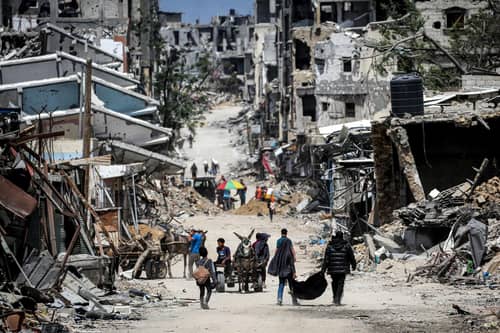
Some 250,000 people have fled Kivu since a peace deal between Gen Nkunda and the Kinshasa government collapsed in August. Nearly 850,000 were displaced in 2005-6, the UN says. Congo's 1998-2003 war and the resulting humanitarian crisis killed some 5.4 million people.
"People are stampeding and the city is panicking," said Julien Paluku, governor of North Kivu. Karl Steinacker, an official with the UN refugee agency in Goma, said: "There are columns of army running away. They are basically abandoning the city."