








RUSSIA and Georgia were last night on the brink of all-out war after a long-standing dispute over a breakaway province erupted into violence.

Russian-backed South Ossetian separatists claimed 1,400 civilians had died, while Georgia accused Russia of inflicting heavy losses in bombing raids.
As the conflict escalated last night, a spokesman for Georgian President Mikheil Saakashvili said he was set to declare a state of emergency and impose martial law. The UN Security Council held two emergency meetings and the US called on Russia to halt aircraft and missile attacks and withdraw its combat forces from Georgian territory.
The White House said President George Bush discussed the situation with Russian Prime Minister Vladimir Putin while both leaders were in Beijing for the start of the Olympics.
Russia claims ten peacekeepers were killed and 30 wounded when their barracks were hit by Georgian shelling yesterday.
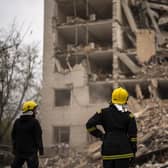
The separatist leader, Eduard Kokoity, claimed hundreds of civilians had been killed and witnesses said the South Ossetian provincial capital, Tskhinvali, was devastated.
In retaliation, Russia sent a column of tanks to the region and threatened to cut air links with Georgia from midnight last night. Georgia's pro-western president, Saakashvili, said in a television address last night that Russian bombing had killed about 30 Georgians, "mostly military men", but that Georgia's forces were in control of Tskhinvali.
Mr Saakashvili said the two countries were now at war.
He said: "We have Russian tanks moving in. We have continuous Russian bombardment since yesterday, specifically targeting the civilian population. Russia is fighting a war with us in our own territory."
Lyudmila Ostayeva, 50, who had fled with her family to Dzhava, a village near the border with Russia, said: "I saw bodies lying on the streets, around ruined buildings, in cars.
"It's impossible to count them now. There is hardly a single building left undamaged."
Kakha Lomaia, the head of the Georgian Security Council, said it will withdraw 1,000 soldiers from Iraq to help fight off Russian forces.
The conflict followed Thursday's hostilities when Georgian forces and South Ossetian separatists exchanged heavy fire, which killed 12 people.
The conflict is believed to have been triggered by Georgia's recent efforts to gain membership of Nato. Yesterday saw the worst outbreak of hostilities since the province won de facto independence in a war that ended in 1992, sparking fears of full-scale war in the region.
Last night a spokesman for the Foreign Office said: "We urge an immediate ceasefire in fighting in South Ossetia and a resumption of direct dialogue between the parties."
Nato, the European Union and the United States also called for an immediate end to fighting.
The Pentagon said it was monitoring events because more than 120 US defence personnel and contractors, including 35 civilians, are in the Tbilisi area to train Georgian forces for deployment in Iraq.
Georgia was ruled by Moscow for most of the two centuries preceding the break-up of the Soviet Union. A staunch US ally, it has angered Russia by seeking Nato membership – a bid Moscow regards as part of a western effort to weaken its influence in the region. The separatist administration in South Ossetia has been trying to gain formal independence since breaking away in a civil war in the 1990s.
South Ossetia has run its own affairs since fighting for independence from Georgia in 1991-92, in the aftermath of the collapse of the Soviet Union.
It has declared independence, though this has not been recognised by any other country.
Russia has troops in the region, on a peacekeeping mandate. But Moscow also supports the separatists.
Mr Saakashvili has vowed to bring South Ossetia and another breakaway region, Abkhazia, back under full Georgian control.
South Ossetians want to join their ethnic brethren in North Ossetia, an autonomous republic within the Russian Federation. Ethnic Georgians are a minority in South Ossetia.

ANALYSIS: A volatile combination at Caucasus crossroads
IT LIES at the heart of the Caucasus – an unstable region that hosts a pipeline pumping oil to Europe from Asia.
As well as emerging as a key energy transit route, South Ossetia is a zone where Russia and the West are vying for influence.
Georgia, formerly part of the Soviet Union, has angered Russia by allying itself with the West and pushing to join Nato.
The crisis is the first to confront the Russian president, Dmitry Medvedev, since he took office in May.
Defence analysts suggest that Georgia deliberately ambushed his tenure as worldwide attention was focused on the Olympic Games in Beijing.
Dr Jonathan Eyal, director of international studies at the Royal United Services Institute, told The Scotsman: "The so-called 'frozen' conflict is now really hotting up. There's no doubt the issue which brought this to a head was America's support for Georgia's membership of Nato. However, the Georgians have had their application postponed at the summit held in Romania in April because it is clear they are not in complete control of the territory.
"The Georgian president has tried to push the matter into a military solution of eliminating the biggest stumbling block to Nato membership.
"World attention is focused elsewhere with world leaders either in Beijing watching the opening ceremony of the Games or on holiday.
"The Georgina gamble was to overrun South Ossetia quickly so they could establish forces on the ground.
"Georgia fired the first shot but will claim that they were driven to it by the skirmishes that have been taking place on a daily basis over the past few weeks.
"And Russian aircraft and armoured vehicles have violated Georgian airspace for months. What happens next will depend on whether a ceasefire can be agreed between the two sides over the next 24 hours."
The full article contains 965 words and appears in The Scotsman newspaper.