








Help Sitemap Home Skip Navigation Contact Us Disability Statement


Prisoners in swap for soldiers' bodies

Premium Article !

Your account has been frozen. For your available options click the below button.
Options

Premium Article !

To read this article in full you must have registered and have a Premium Content Subscription with the The Scotsman site.

Subscribe

Registered Article !

To read this article in full you must be registered with the site.

Click on thumbnail to view image

Published Date: 17 July 2008
ISRAEL yesterday handed over five Lebanese prisoners to Hezbollah after the Shiite guerrilla group returned the bodies of two Israeli soldiers seized in a cross-border raid in 2006.
Among the men who arrived at the border in a Red Cross convoy was Samir Qantar, Israel's longest-serving Lebanese prisoner, who was mobbed by well-wishers on his arrival.

Hezbollah had prepared a triumphal welcome for the five men freed under a de
al seen by many Israelis as a painful necessity, two years after the two soldiers' capture sparked a 34-day war that killed some 1,200 people in Lebanon and 159 Israelis.

Israel retrieved the bodies of Ehud Goldwasser and Eldad Regev only after agreeing to release Qantar, who had been serving a life term for the deaths of four Israelis, including a four-year-old girl and her father, in a 1979 Palestinian guerrilla raid on an Israeli town.

The four others were Hezbollah fighters captured in the 2006 conflict. All five were flown to Beirut ahead of a huge Hezbollah rally in the evening.

The Red Cross drove the five to the headquarters of UN peacekeepers at the border village of Naqoura, where Hezbollah had earlier handed over two coffins containing the soldiers' bodies. Hezbollah had never disclosed whether the two men were dead or alive, and it is still not clear how they met their deaths.

"The Israeli side will now hand over the great Arab mujahid (holy warrior] Samir Qantar and his companions," Hezbollah said after delivering the bodies.

The fathers of the two Israeli soldiers spoke of their pain at watching the transfer of their sons' coffins on television.

"It is not easy to see this … confronting this reality was difficult, yes," Shlomo Goldwasser told Israel radio.

Zvi Regev said: "It was a terrible thing to see, really terrible. I was always optimistic, and I hoped all the time that I would meet Eldad and hug him."

Goldwasser's father-in-law, Omri Avni, said of Qantar, who was 17 at the time of the 1979 raid: "The despicable murderer who killed the children 30 years ago has gone home and finally, for the first time in his life, has done a good deed by leaving this place and bringing about the return of Ehud and Eldad."

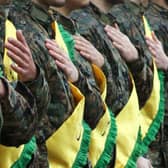
Meanwhile, across southern Lebanon and on the coastal highway from Naqoura to Beirut, yellow Hezbollah flags fluttered. "Liberation of the captives: a new dawn for Lebanon and Palestine", one banner read.

Israel denounced the planned festivities. "Samir Qantar is a brutal murderer of children and anybody celebrating him as a hero is trampling on basic human decency," a spokesman for Ehud Olmert, the Israeli prime minister, said.

Under the deal, Israel also handed over the bodies of eight Hezbollah fighters killed in the 2006 war, and those of four Palestinians, including Dalal Mughrabi, a woman guerrilla who led a 1978 raid on Israel. The four were among the nearly 200 Arabs killed trying to attack Israel whose bodies are to be sent to Lebanon. Hezbollah returned the remains of other Israeli soldiers killed in the south.

Israel is also to free scores of Palestinian prisoners at a later date.

The Palestinian group Hamas said yesterday's swap strengthened its hand in demanding freedom for hundreds of prisoners in exchange for captured Israeli soldier Gilad Shalit.

Analysis - Uneven trade enhances sense of failure over war

Ben Lynfield

AFTER yesterday's uneven exchange with Hezbollah, Israel must now decide whether it is willing to cut another unsavoury deal, this time with Hamas, the Islamic resistance movement that rules Gaza.

Ismail Haniya, the leader of Hamas, yesterday warned Israel it would have to "pay the price" for the release of Sergeant Gilad Shalit, captured in a cross-border raid two years ago. "It is hard to see thousands of prisoners in Israeli jails," said Mr Haniya.

Analysts believe the Israeli government will buy Sgt Shalit's freedom with the more than 400 prisoners Hamas is demanding and for the same reason it agreed yesterday to release its most notorious prisoner and four others in exchange for corpses: the emotional resonance that families of missing or fallen servicemen have in a society that remains – at least in this one respect – tightly knit.

"Everyone here serves in the military, the elite and their children serve. It is not a peripheral group saying bring our sons back. It is something that speaks to everyone," said Uri Dromi, a former spokesman for Yitzhak Rabin, the late prime minister. Another factor in the pressure to retrieve corpses and body parts is the stress in Jewish religion that the dead – including all the remains of the body that can possibly be gathered – must be laid to rest with a ritual funeral.

In the Hamas prisoner exchange, Israel will have to release the dozens of MPs and political leaders it arrested in the occupied West Bank two years ago after Sgt Shalit's capture. This is likely to come as another blow to the moderate Palestinian leader, Mahmoud Abbas and his Fatah movement.

In a bitter irony, the exchange with Hezbollah was codenamed by the Israeli army "Operation Return of the Sons". Along with the images of a smiling Samir Qantar, the freed prisoner, it was the pictures of the two black coffins that contained the remains of soldiers Eldad Regev and Ehud Goldwasser that were the dominant images in Israel. Baruch Aran, whose brother Danny was killed by Kantar in a 1979 terrorist attack in which he also smashed the skull of Danny's four-year-old daughter with a rifle butt, said he changed the TV channel rather than watch Kantar walking free. "The hardest part was that they admire this animal," he said.

The swap reinforced the sense that the war two years ago with Hezbollah – launched by Ehud Olmert, the prime minister, to free Regev and Goldwasser after a Hezbollah cross-border raid – was a failure.

"We should have opened negotiations to bring them back," said Menachem Klein, a political scientist at Bar Ilan University near Tel Aviv. "We would have saved the lives of all the soldiers and Lebanese civilians during the war and kept Beirut undestroyed."


The full article contains 1036 words and appears in The Scotsman newspaper.
Page 1 of 1

  • Last Updated: 16 July 2008 9:34 PM
  • Source: The Scotsman
  • Location: Edinburgh


Sister Newspapers:
Press Complaints Commission

This website and its associated newspaper adheres to the Press Complaints Commission’s Code of Practice. If you have a complaint about editorial content which relates to inaccuracy or intrusion, then contact the Editor by clicking here.

If you remain dissatisfied with the response provided then you can contact the PCC by clicking here.