








Help Sitemap Home Skip Navigation Contact Us Disability Statement


Monday, 7th July 2008

Premium Article !

Your account has been frozen. For your available options click the below button.

Options

Premium Article !

To read this article in full you must have registered and have a Premium Content Subscription with the The Scotsman site.

Subscribe

Registered Article !

To read this article in full you must be registered with the site.

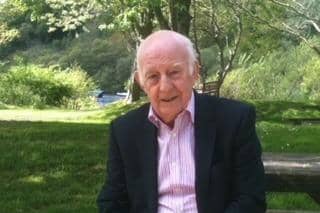
George Ogg


Click on thumbnail to view image

Publisher
Born: 6 August, 1914, in Glasgow.

Died: 18 April, 2008, in Troon, aged 93.


GEORGE Ogg was a publisher who produced a range of textbooks used by schoolchildren throughout Britain. He was born two days after the outbreak of t
he First World War and educated at Govan High School, leaving in the early 1930s with a higher leaving certificate. Rather than go to university, he chose to join the Glasgow publishing firm Blackie & Son Ltd, where he was employed at first in the publicity department. In the mid-1930s he was promoted to the editorial department and was assistant educational editor in 1939 at the outbreak of the Second World War.

He volunteered for the forces in 1940 and was destined for the Intelligence Corps because of his knowledge of languages (being fluent in Italian, German and French). At the time of the fall of France, the situation was chaotic and he was sent to the Royal Artillery instead.

After basic training he was posted to the 15th (Isle of Man) Light Anti-Aircraft Regiment RA (TA), which was based in Glasgow. In November 1940 his regiment moved to Cairo; almost immediately after his arrival there, his transfer to the Intelligence Corps came through.

His first campaign was in Abyssinia, where he joined the east African forces. Lodged with an Italian family, he was able to perfect his command of the language. After extensive service in Abyssinia, he was posted back to Cairo, travelling via Aden by Arab dhow. At the time he held the rank of sergeant, but by 1943 he had been sent to the Middle East OCTU in Acre and was ultimately commissioned in the Intelligence Corps. He served with the Eighth Army in north Africa and moved with them to Italy for the duration of the Italian campaign, advancing, as the commander of a field security unit, from the heel of Italy to the foothills of the Alps and on to Vienna. By the time the war ended, he was a captain and had been mentioned in dispatches for service in the Italian campaign, in particular for his part in the capture of a German spy, landed by submarine.

The war over, he returned to his civilian occupation with Blackie & Son, and in 1947 married Margaret Macfadyen, whom he had known since his tennis club days before the war. They raised a family in Glasgow, initially in Clarkston and later in Newton Mearns.

His publishing career flourished steadily and he became managing editor of the firm's educational division. In this capacity he was responsible for adding many successful educational publications to the firm's list – the most prominent the Modern Mathematics for Schools series, compiled by a group of the best-known Scottish maths teachers.

The series was published jointly with Chambers of Edinburgh and was used by schools throughout Britain as the standard secondary maths textbook, selling several million copies in its lifetime.

Earlier, he had written two books for children which were published in the Kingfisher series and used for reading development in all British primary schools.

He was promoted to the board of Blackie in the 1960s as educational director, later becoming vice-chairman and finally chairman of the company. He retired in 1981, having served 50 years with the firm, broken only by war service.

For many years, he acted as representative of the Scottish publishers with the educational group of the UK Publishers' Association, based in London, and was chairman of the educational books committee, which produced, among other useful contributions, a notable report Expenditure on Schoolbooks in the United Kingdom.

An avid reader, he was also keen on classical music and a capable pianist. He loved poetry, in particular Burns, which he could recite from memory. All his life he had been a keen sportsman. In his teens and early twenties his enthusiasm was for football and tennis, being talented at both. In his later years, however, golf became his main interest and he played the game with great relish, into his eighties at Eastwood Golf Club. His continuing passion was as a supporter of Rangers, being a regular attender at Ibrox and a season-ticket holder all his life.

His saddest time came with the death of Margaret in 1988. He managed to live alone, but still with a verve for life, into his nineties, helped by his daughters, before finally moving to Troon.

Despite his many successes in life, he remained a modest and unassuming individual, one of the many remarkable people to emerge from Govan High. Probably his proudest accolade was given him by a contemporary at a time when all the family publishing businesses were being eaten up by the big battalions – "George Ogg," he said, "was the last of the gentleman publishers."

He is survived by his two daughters, five grandchildren and a great-grandson.


The full article contains 812 words and appears in The Scotsman newspaper.
Page 1 of 1

  • Last Updated: 11 May 2008 6:44 PM
  • Source: The Scotsman
  • Location: Edinburgh


Sister Newspapers:
Press Complaints Commission

This website and its associated newspaper adheres to the Press Complaints Commission’s Code of Practice. If you have a complaint about editorial content which relates to inaccuracy or intrusion, then contact the Editor by clicking here.

If you remain dissatisfied with the response provided then you can contact the PCC by clicking here.