

Born: 1 September, 1914, in Blantyre, Nyasaland. Died: 29 February, 2008, on Lismore, aged 93.
ALASTAIR Livingstone held one of the oldest titles in Scotland. His family have been hereditary holders of the Great Staff of St Moluag since the saint'
s death in the 6th century. He was also Baron of Bachuil – taken from the estate on the Isle of Lismore, which lies on the Linn of Lorne opposite Oban. Livingstone was always an ardent supporter of the Clan MacLea and saw distinguished service in the Middle East – as a soldier during the war and in commerce thereafter.
The Highland Livingstones are one of the oldest clans in Scotland and were originally known by the Gaelic name McOnlea, now spelled McLea or MacLea.
William Jervis Alastair Livingstone of Bachuil was the son of a farmer in Nyasaland who was killed in a native disturbance when he was a child: Livingstone inherited his titles on his father's death in 1915. His mother returned to live in Port Appin and Livingstone attended Loretto School before reading law at Edinburgh University and Clare College, Cambridge, where he also studied Arabic. He then joined the Sudan political service.
In 1945 Livingstone joined the West Yorkshire Regiment and served in the western desert and then guarded oil supplies from Iraq. Livingstone was commissioned but, with his invaluable knowledge of Arabic, was moved to the Intelligence Corps and served with the Palestine government in administering Galilee.
After the war this experience was of great use when he was appointed chief personnel officer for Iraq Petroleum. In 1966 he was brought back to the head office of Iraq Petroleum and in 1973 he retired after having served for some years on the Council of Anglo-Arab British Understanding.
His retirement gave Livingstone the opportunity to return to his beloved white painted house on Bachuil. He devoted his energies to improving the estate and modernising the running of the island. To this end, Livingstone acted as chairman of the community council and was the registrar of the births, deaths and marriages. For more than 50 years he was an elder of the kirk at Lismore.
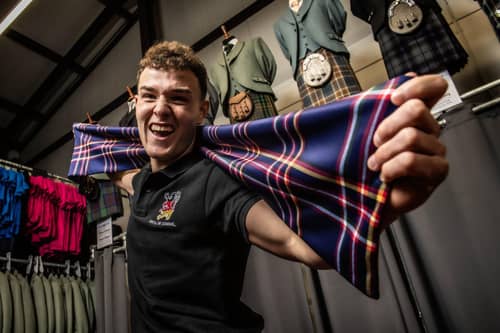
Livingstone was invariably seen in the kilt – wearing the MacLea tartan – and, with his distinguished white hair, looked every bit a clan chief. He and his wife, Valerie, acted as hosts at many clan gatherings and visitors from abroad were particularly welcome. He adopted the Arab saying – "your house is my house" – and was always a courteous and generous host.
Livingstone was a keen student of the 1745 rebellion and was chairman (1981-90) of the 1745 Association. He supported local events and served as a member of the Argyllshire Gathering, the Convention of the Baronage of Scotland and on the Standing Council of Scottish Chiefs.
Livingstone's family have well documented claims to be holders of the oldest title in the UK. The coarb (successor) of St Moluag was the abbot of Lismore and the abbots of the 100 monasteries which emanated from St Moluag followed the rule of the coarb. A contemporary of St Columba, St Moluag converted the Picts to Christianity in the 6th century. The title can be dated back to Moluag's death in 592 and is held "by the grace of God". The Great Staff of St Moluag was passed to an ancestor of Livingstone and the family have remained its hereditary keepers. The staff was paraded at a heraldic congress in St Andrews by Niall Livingstone, Younger of Bachuil, in 2006 in the presence of Princess Anne.
In 1974 the staff was restored to Bachuil after being held for many years at Inveraray. In 2004 Julian Calder published The Oldest: A Fascinating List of Britain's Oldest Everything, with a picture of Livingstone proudly holding The staff on the shores of Port Ramsay. The book documented the history of the title in detail.
Livingstone is survived by Valerie, his wife of 56 years, and their two sons and three daughters. The titles are inherited by their eldest son, Niall.
The full article contains 683 words and appears in The Scotsman newspaper.