














Help Sitemap Home Skip Navigation Contact Us Disability Statement


The nuclear threat to our cuppa

Premium Article !

Your account has been frozen. For your available options click the below button.

Options

Premium Article !

To read this article in full you must have registered and have a Premium Content Subscription with the The Scotsman site.

Subscribe

Registered Article !

To read this article in full you must be registered with the site.

Click on thumbnail to view image

Published Date: 05 May 2008
DURING the Second World War, it was, according to Winston Churchill, "more important to the soldiers than munitions", while George Orwell considered it "one of the mainstays of civilisation".
Now it has emerged the role of the great British cuppa was so important in the 1950s that one of the main fears was that the country would run out of tea.

In documents released today under the Freedom of Information Act, Whitehall officials wrot
e that the tea situation would be "very serious" if there was a widespread attack on the UK by A bombs and H bombs.

Such was the severity of the situation that officials – drafted in to draw up contingency plans for food supplies in the event of a nuclear war – recommended that tea was rationed to just 1oz per week, half the ration imposed during the war and enough to make one or two weak cups a day.

It was anticipated that stocks would be lost and imports significantly delayed. The papers, released by the National Archives in Kew. "The tea position would be very serious with a loss of 75 per cent of stocks and substantial delays in imports and with no system of rationing it would be wrong to consider that even 1oz per head per week could be ensured," reads one paper dated April 1955. "No satisfactory solution has yet been found," it added.

Tea, which was rationed just two days after war broke out in 1939 and was restricted until 1952 in order to conserve stocks, was said to be morale-boosting during the war and continued to be considered an essential in 1950s Britain.

Concerns were also raised about shortages of other food stuffs, including bread, milk, meat, fats and sugar.

The Ministry of Food was asked to draw up contingency plans for how to feed the nation if feared attacks on London, Birmingham, Merseyside, Manchester and Clydeside – all potential H-bomb targets – were carried out.

Another of the documents, which date from 1954 to 1956, stated: "The advent of thermo-nuclear weapons ... has presented us with a new and much more difficult set of food defence problems."
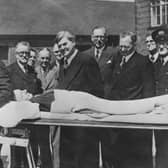
The objective of planning should be to be "completely ready to maintain supplies of food to the people of these islands, sufficient in volume to keep them in good heart and health from the onset of a thermonuclear attack on this country."

The report adds: "It has become increasingly clear that the severity of the attack which the enemy could launch would produce a catastrophe in the face of which past measures would be fatally deficient."

Arrangements for the stockpiling of food and emergency feeding and equipment were among items listed for discussion at ministry meetings.

The former wartime emergency bread organisation was re-established and emergency officers from the trade appointed, one document noted.

Paul Addison, a post-war historian, said that the revelations were "extremely interesting" and that the concerns would have been driven by the "hang-over" of Second World War rationing and shortages.

The author of Churchill: the Unexpected Hero added that the link between tea and state of British morale was in part influenced by the wartime leader. "Churchill had very strong feelings about tea," Mr Addison said. "He thought the British moral depended on it, possibly quite rightly.

"This was a politician who was interested in food issues from early in his career and led a campaign to keep down the price of bread.

"He was very conscious that the nation marched on its stomach. Even in postwar Britain, there were a lot of concerns about nutrition.

"There was still a wartime mentality – that is key to all this. The fear would be that people just wouldn't have enough to keep going."

OUR FAVOURITE DRINK IS GOOD FOR THE HEALTH

TEA is Britain's favourite hot drink, with 165 million cups consumed daily compared with 70 million of coffee.

The fashion for tea was inspired by Catherine of Braganza, the Portuguese bride of Charles II, who introduced it to England's royal court in the 17th century.

China is the largest producer of tea in the world with an output of 1,028,000 tonnes. India is second with 956,000 tonnes.

The tea bag was invented in the United States in 1908, but it did not catch on in Britain until it was promoted by Tetley in 1953.

Tea is a natural source of polyphenols and flavonoids, which have antioxidant properties. That means they soak up free radicals, which have been associated with cancer and heart disease.

Experts claim that drinking four cups a day gives health benefits, including promoting iron absorption.

There are 1,500 varieties grown around the world.


The full article contains 788 words and appears in The Scotsman newspaper.
Page 1 of 1

  • Last Updated: 04 May 2008 10:14 PM
  • Source: The Scotsman
  • Location: Edinburgh
 
1

Charles Linskaill,

Edinburgh 05/05/2008 00:41:36

'AH', You See!,..

'Its all in the Tea',and this is why I will live until 103!

:D

'Of Course' our,..'Boy Wonder' is jealous of this Fact, and has a, 'Mental Act'!

In trying to work out,..'My Artefact'!

Now have some Tea Boy Wonder!,,'there's a good boy' :-))
2

Douglas,

Bathgate 05/05/2008 01:10:15
Careful Charles, he could turn out to be your Darleeling young wife. :o)

3

Charles Linskaill,

Edinburgh 05/05/2008 01:37:19

Douglas,..

:-)))

That's what I worry about!
4

Guga II,

Rockall 05/05/2008 05:04:42
Since when did that creep Churchill drink tea. The man was sozzled on whisky and champagne all through the war, to go with his caviar and large cigars. No rations for him, like there was for the hoi polloi.
5

Boy Wonder,

05/05/2008 08:56:44
I never drink tea or coffee. I prefer clear water or fruit juice. I don't want to live till 103 either, Chuckles. Look at you at 95, coping with dementia and senility. You're an old old man ... and your DYW has been seen with another. A titled gentleman going by the moniker of Earl Grey!

Would you like a Rich Tea or Digestive to drop in your morning cuppa??
6

Charles Linskaill,

Edinburgh 05/05/2008 09:47:16

Boy Wonder,

Even if my DYW was seen with the,..."Earl", he is NO match for me being the,..

'Pure Assam' of a Man, I am!

And forget your,..'Dunking Digestive'!

I wouldn't trust you for a,...'LapSang Souchong',,

Even with your,..'Socks On'! :-))
7

donald anderson it's me,

05/05/2008 09:47:20
Time to dress up as Highlanders and dump the tea in the Clyde. Anyone for a tea party?
8

Venachar,

05/05/2008 10:01:19
Can we grow tea in this country ...mmmm, No!

Can we grow cannabis.....mmmm, Yes!

Who cares if we ever run out of tea. Grow cannabis then nobody would worry about anything ever again.
9

Pomodora,

Gravesend 05/05/2008 10:02:01
I have no idea what goes into tea-bags, it's certainly not tea. And that's why I still opt for the leaf.
10

FrankJB,

Old York 05/05/2008 11:04:51
re #9, I hate to disillusion you Pomodora, but in most instances, the tea in bags is a better grade than in leaf tea, brand for brand. When they make a tea blend the "dust" is sieved out of the tea for bags (or it would leak out through the little perforations) and kept in the "leaf" tea. Dust tea is cheap and not nice.

By the way, does anyone check chine tea - or indian tea come to that for all of the "orrible chemical they lavishly spray on in those countries?


11

Buckfastleigh,

05/05/2008 11:11:02
"You will have had your tea, Bruce" On calling at a Fifer maiden Aunt at 4pm after a gruelling car journey to Forfar from London. What excellent welcome a cup of tea in such circumstances...No wonder the problem is the tea: its cost I believe, or so i was told. Personally speaking Aunty Pru could have offered us some Buckfast instead.
12

Guga II,

Rockall 05/05/2008 12:46:36
#10 I agree that tea bags are not "dust". They use the sweepings off the floor.
13

Charles Linskaill,

Edinburgh 05/05/2008 14:53:03

Guga,

'Aye',....that's what I say!,.."sweepings off the floor",to this Guy that insists on purchasing the cheapest, 'Tea Bags" ever!

'I mean to say', you need 4bags for a cuppa!

Disgusting!, now this Guy insists his, "Tea Bags" are giving him a headache and 'Bad Stomach'! :))

14

TimW1234,

Ottawa, Canada 05/05/2008 16:22:32
Boy Wonder and Charles Linskaill are at it AGAIN!

What they need is a few "wee drams" first thing in the morning to calm them down!

I can't get through my VERY early mornings - I arise between 3:30 and 4:00 a.m. to walk my beautiful Black Labrador "Chester" then and then have a cup or three of English Breakfast or Irish Breakfast or Orange Pekoe or green tea.

Tea is good for your health and Winston Churchill probably had tea when forced to by Lady Churchill then switched to his daily bottles of brandy and champagne.

The only way to go - unfortunately it brought on severe incontinence when he got old.
15

Kentucky Bloke,

Henderson 05/05/2008 16:50:17
With a race horse breaking both ankles at the KY Derby, most Kentuckians fall back on Bourbon Whisky to ease the pain. Of course, we grow pot in the Daniel Boone National Forest
16

Celyn,

Glasgow 05/05/2008 21:39:38
"...The fashion for tea was inspired by Catherine of Braganza, the Portuguese bride of Charles II, who introduced it to England's royal court in the 17th century..."

Eh? "England's royal court"?

Surely Catherine of Braganza wasn't even BORN until a fair while after the Union of the Crowns.

17

The Former Mr. Angry,

Perth 05/05/2008 21:44:06
"Cripes that must have been an ehbsolutely huge explosion there - about 10 megatons I'd say - more tea vicar?"


Comment on this Story


In order to post comments you must Register or Sign In


Sister Newspapers:
Press Complaints Commission

This website and its associated newspaper adheres to the Press Complaints Commission’s Code of Practice. If you have a complaint about editorial content which relates to inaccuracy or intrusion, then contact the Editor by clicking here.

If you remain dissatisfied with the response provided then you can contact the PCC by clicking here.