






IT WAS supposed to ease tensions within multi-cultural Britain, helping diverse communities to heal divisions caused by the terrorist attacks in London and Glasgow.
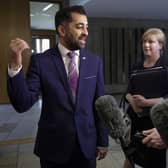
But a proposal to make Britain's teenagers pledge an oath of allegiance to the Queen was immediately dismissed by Alex Salmond, the First Minister, as "Monty Python-esque" – a description which captured the Anglo-centric origin of the idea, as well a
t the contempt with which it is likely to be viewed north of the Border.
The plan – put forward by Lord Goldsmith, the former attorney general, in his review of citizenship – has been prompted by concerns that Britain's diverse communities don't unite in a common bond as they do in other countries, such as the United States or France.
Lord Goldsmith acknowledged his plan would "raise particular issues" in Northern Ireland and conceded regional arrangements might have to be made.
"I absolutely expect that there will be scepticism about it," he said. "But there was scepticism about the proposal to have citizenship ceremonies for new applicants, and they have gone extremely well."
The proposal will also prove contentious for the two million or so avowed republicans in the UK who still consider themselves citizens.
Although Mr Salmond has insisted he is a monarchist, he pointed out that education was a devolved matter and that the proposals would not be considered in Scotland.
In Wales, the sentiments were the same. Ieuan Wyn Jones, the deputy first minister, said the proposals were inappropriate.
Meanwhile, a Stormont Assembly member – the Social Democratic and Labour Party representative Dolores Kelly – said that Lord Goldsmith's proposal was "divisive".
Ms Kelly said any form of oath to the Queen would not be appropriate in Northern Ireland. "This proposal would be divisive, dangerous and counter-productive," she said.
The Labour peer Baroness Kennedy gave one of the most devastating assessments of the citizenship ceremonies for teenagers, saying: "The symbols of a healthy democracy are not to be found in empty gestures, and I'm afraid I see this as an empty gesture."
She has admitted that her hostility is partly because she is Scottish.
Liam McArthur, the Scottish Liberal Democrat enterprise spokesman, said the idea was "utter nonsense". He added: "Even at their most jingoistic, the Tories didn't contemplate citizenship ceremonies for all."
Jim Mather, the Scottish enterprise minister, said calls for youngsters to take part in British citizenship ceremonies would be opposed north of the Border.
He argued that the move would be an own-goal for Gordon Brown. The Prime Minister has repeatedly asserted his British credentials.
"We don't support it and neither do the vast majority of parents, teachers and children in Scotland," Mr Mather said.
But for English politicians, the ideas also feel distinctly foreign.
Nick Clegg, the Liberal Democrat leader, said: "People should not feel that being British is about swearing allegiance; it should be about taking an active role in society. Until people feel they have a genuine say in the system, they will never feel like true citizens."
During a Commons exchange, Nick Herbert, the shadow justice secretary, declared it "profoundly un-British" to demand the public swear oaths of allegiance, subscribe to statements of values, or fly flags on their lawns.
"The public will surely see straight through synthetic patriotism," he predicted.
Lord Goldsmith's review is entitled Citizenship, Our Common Bond. But by the end of yesterday, the only common bond to emerge was near universal hostility to the idea from political parties and teachers.
Many said the ceremonial bells and whistles proposed had nothing to do with Britishness.
The debate about citizenship is as complex as its roots. The concept, however, is not some ancient right, but a relatively modern invention that was introduced through the 1914 British Nationality and Status of Aliens Act.
It gave all those born within "His Majesty's dominions and allegiance" the right to citizenship.
But after the Second World War, the concept had to be reviewed as many of the self-governing dominions developed stronger identities.
Today, there are six categories of citizenship, ranging from British citizens to those who are purely British subjects. Lord Goldsmith admitted that in the past, this variation had led to discrimination against white and black members of overseas communities.
The review proposes to remove the rights of Irish and Commonwealth citizens to vote in UK elections – an idea the Unlock Democracy think-tank has criticised as "pulling up the drawbridge" and forgetting Britain's history.
In 1981, the government rejected the idea that any reform of citizenship should also cover civic rights and responsibilities, as this was "self-evidently an unrealistic aim".
But in 2008, the government would like to make this a condition.
The headline measure – that all teenagers, including those born in the UK, should be made to swear their allegiance to the Queen to foster a sense of belonging – echoes the changes made for new citizens in 2004.
Lord Goldsmith tried to play down suggestions that his proposal was made to counter a crisis of national identity.
He said, however, that research showed "there's been a diminution in national pride – in this sense of belonging".
Mr Brown, who commissioned the report, seemed to give it his approval. His spokesman said the 138-page review contained interesting ideas that would provoke a "lively" debate.
But John Dunford, the general secretary of the Association of School and College Leaders, said: "Schools will reject it as an un-British idea imported from America, which does not fit into their ethos or culture.
"This is a half-baked idea which should be allowed quietly to go mouldy."
In fact, the report itself isn't entirely British. Among the long list of contributors to it is one Michael Chertoff, the secretary of homeland security in the United States.
HOW DO YOU FEEL?"I FEEL Scottish because I am Scottish. I was born in Scotland, I work and I live here – what else would I be? The only reason Britishness is such a big issue with Gordon Brown is because he wants to prevent independence at all costs and make himself out to be less Scottish so he can keep his job as Prime Minister.
"I've got a son of 16 and I would discourage him from swearing allegiance. It's nonsense; it's almost a form of Americanisation."
Brian Reynolds, 45, self-employed joiner, West Linton."Years ago I would have said I was British without thinking about it. When I was at secondary school, Scottish nationalism was a bit of a joke. But now it makes sense.
"There's been a Renaissance in Scottish literature and films and in other ways which have linked up leaving me feeling more Scottish than British.
"I'd leave it up to the kids to decide what they want to do about the allegiance ceremonies."
Helen MacDonald, 48, IT specialist, Edinburgh."I've always described myself as Scottish on official forms. This is a separate country, so why would I want to say I was British? It doesn't feel right to say British.
"I don't need to swear allegiance to make me behave better, thank you very much.
It sounds like something legal, like being in a courtroom and promising to tell the truth."
Kirsty Whyte, 17, nursery nurse, Morningside, Edinburgh."My father is English and my mother is Scottish. But I was born here and have always been aware that we are a separate country.
"I can't ever imagine why I would want to describe myself as British unless I was in some far-flung country where no-one had ever heard of Scotland. But considering how well-travelled Scots were in the past, and are now, I can't see that happening. You can't force people to be what they're not; it all seems a bit heavy and politically correct."
Alex Thomson, 28, sales manager, Linlithgow.
The full article contains 1309 words and appears in The Scotsman newspaper.