
















RUSSIAN planes dropped bombs this month within 50 metres of a pipeline that British oil company BP was in the process of reopening through Georgia, according to witnesses.

Residents yesterday showed deep craters alongside the pipeline, which runs between Azerbaijan's capital Baku, on the Caspian Sea, and Georgia's Black Sea port of Supsa.
It was reported on 12 August that Georgia had accused Russia of bombing the p
ipeline, without causing serious damage. Russia denied any such attacks.
"They started dropping the bombs at seven o'clock in the evening of the 11th," said Adam Zaridze, 26, a herdsman. "In one day they dropped 42 bombs," he said. "They were black planes … The cattle ran all over the place. Some of the cattle were killed." A woman suffered a fatal heart attack from fear, he said.
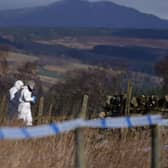
Next to a marker post above the underground pipeline, 15 miles from the border with Azerbaijan, three craters were visible within 50m of it. The largest was about 3m deep and 8m in diameter.
A line of craters could be seen running perpendicular to the pipeline for more than a mile. Cattle were grazing beside a churned-up area larger than a football pitch with two large craters in the middle.
Pipelines through Georgia, bringing oil and gas westwards from the Caspian Sea, are strategically important as they bypass Russia and help reduce western energy dependence on Moscow. The European Union relies on Russia for about a quarter of its gas and much of its oil.
This month's Russian- Georgian conflict rattled energy markets and western governments, which saw it as an attempt by Russia to reassert control over a former Soviet republic seeking to move closer to the West.
Matt Taylor, a BP spokesman, said it was aware of the bombing, but did not wish to comment. When fighting began, BP was reopening the pipeline, which was pumping 150,000 barrels per day until it was closed for maintenance in 2006.
He said the idea was reopen it at 90,000bpd to "provide some flexibility" and back-up for the main oil pipeline across Georgia, which runs from Baku via Tbilisi to Ceyhan in Turkey.
That pipeline carries between 700,000 and 800,000bpd, but was closed for two weeks this month after an explosion in its Turkish stretch. It runs close to the Baku-Supsa pipe, as does an important gas pipeline from the Caspian to Turkey, but neither were damaged in the conflict.