











Help Sitemap Home Skip Navigation Contact Us Disability Statement


T in the Park

Premium Article !

Your account has been frozen. For your available options click the below button.

Options

Premium Article !

To read this article in full you must have registered and have a Premium Content Subscription with the Edinburgh Evening News site.

Subscribe

Registered Article !

To read this article in full you must be registered with the site.

Put the nettle on


Click on thumbnail to view image

Published Date: 07 August 2004
A FIELD full of nettles may not be every farmer’s idea of a successful harvest.
But in a story with a real sting in its tale, Lothian farmers are set to make millions by simply nurturing the common weed.

The nettle is poised to shed its unsavoury image, and instead take pride of place on the fashion catwalks of Paris, Milan and New York.

That’s if Professor Ray Harwood, from Leicester’s De Montfort University, has his way. He told farmers in Edinburgh and the Lothians today that nettles are going to become the profitable future of clothing manufacture.

And he has already managed to persuade a brave model to wear pink underwear made of nettle fabric and a Scottish company recently used his ideas to make a kilt from the weed.

"Farmers in Scotland may be sitting on a real gold mine," the Professor said. "We’re involved in the first contemporary British project to develop nettles as a fabric and we’re looking for a native British nettle to use.

"Currently, we’re using German nettles but we really need some good strong, tall nettles and they tend to grow where there is a lot of rain. Edinburgh could be perfect."

As professor of the textile engineering and material research group at De Montfort, Prof Harwood’s research is called Sting - Sustainable Technologies in Nettle Growing.

The project was started earlier this year with funding from the Department of Environment Food and Rural Affairs and its agent, the Central Science Laboratory, in York. Prof Harwood insists it is a serious project.

"Cotton production in the world is currently less than consumption so nettles are therefore a real alternative. The study is still in its early stages but this could be very economically viable.

"I envisage hundreds of thousands of acres of land across Britain farming nettles. It’s a very hard-wearing fabric and could be very useful for big industries."

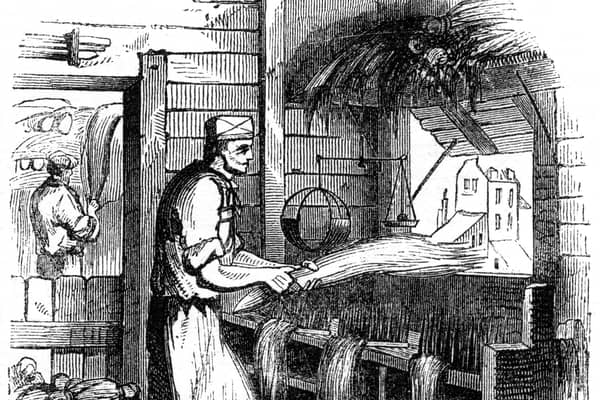
The professor also points out that this is not a new idea, but has a long history.

"For instance, Elizabeth I slept in a nettle bed, which we think means the textile covering rather than the stuffing. Napoleon’s army is also thought to have been clad in nettles, and the plant was frequently used to make tablecloths and sheets in Scotland.

"However, the nettle’s finest hour arrived during the First World War," he said. "Britain and the United States controlled the whole of the cotton industry and we didn’t supply the Germans. There’s evidence they used nettles for making things such as sandbags, straps, rucksacks and harnesses."

More recently, De Montfort textile design student Alex Dear designed her own lingerie from a shipment of nettles from Germany. The 23-year-old from Cambridge, who also modelled her pink camisole and knickers, said: "I investigated and tested the fibres and had the yarn made up. Just for fun I made the lingerie which I called nettle knickers."

But she added: "It’s not terribly comfortable when it’s next to your skin, so anything you made from it would probably have to be lined. It is a slightly hairy fibre."

Lochcarron kilt makers from Galashiels, the world’s largest manufacturers of authentic tartans, also recently produced a nettle kilt for national Be Nice to Nettles Week.

The event was organised by Blyth Valley Borough Council in north-east England.

A spokeswoman said: "We had a lot of fun, but it is for a serious cause - the humble nettle has played, and continues to play, an important role in the natural world."

John Playfair, an agricultural contractor from Longniddry, East Lothian, said the idea of farming nettles was a "bit extreme but not beyond reason".

"We have to look at all possibilities and nettles certainly wouldn’t be a problem to grow. I don’t see nettles as the saviour of the farming industry, but we should always be willing to try something different."

The full article contains 678 words and appears in Edinburgh Evening News newspaper.
Page 1 of 1


Featured Advertising


Sister Newspapers:
Press Complaints Commission

This website and its associated newspaper adheres to the Press Complaints Commission’s Code of Practice. If you have a complaint about editorial content which relates to inaccuracy or intrusion, then contact the Editor by clicking here.

If you remain dissatisfied with the response provided then you can contact the PCC by clicking here.