




WITH a leather sofa, a widescreen television and a spread of Christmas decorations in the front room, Caroline Mockford might appear to have the life of a typical mother of three.

Christmas shoppers at Princes Street, Edinburgh Picture: Jayne Emsley
But behind the tinsel lies a story that is now played out in about one in five households across Scotland.
Look more closely and you learn that the presents for her 10-year-old daughter, Emma, were bought at a charity shop: two board games at £2 each. The small, artificial Christmas tree given pride of place in the living room of the housing association flat she shares with partner Willie has been donated by a charity.
Her one extravagance was a new copy of the Guinness Book of Records. It cost £18, a sum many will splash out on stocking fillers. To save for it, however, Caroline has often eaten only a slice of toast for dinner for the past two weeks.
This is the face of poverty in Scotland in 2007.
Caroline's story has been revealed on the day that an influential committee of MPs publishes a report showing that almost a million Scots are living in poverty.
A wide-ranging investigation by members of the Scottish Affairs Committee also estimates there are 250,000 children in Scotland caught in the poverty trap.
The report argues that while poverty rates have fallen, those reductions had not been evenly spread across society.
The largest falls have been in the areas of child poverty and pensioner poverty – both the subject of high-profile government campaigns – but poverty among working age adults has remained broadly unchanged.
MPs highlight the "considerable barriers" some people face when looking for work – inadequate childcare, geographical isolation and provision for disabilities.
The new report contains a catalogue of recommendations, including a call for the UK government to review the criteria for benefits aimed at combating fuel poverty and says there should be greater co-operation between Westminster, the Scottish Government, energy companies and others to tackle fuel poverty.
A number of recommendations have been made to tackle illegal money lending. In a strongly worded attack on financial institutions, the MPs claim a "thriving industry" is based on exploiting the poor. And some committee members go further and say the courts should have the power to impose an interest rate cap.
Mohammad Sarwar, chairman of the committee and MP for Glasgow Central, said it was "frightening" how people who borrowed modest sums could find their debt mounting by the combined effect of high interest rates, penalty charges and service charges.
"People who are borrowing a few thousand pounds end up losing their belongings and losing their home," he said. "We are not talking about illegal money lenders here, although that is a problem.
"For so-called legal money lending, how can someone justify that when the bank rate is less than 6 per cent, people will be paying 20 times more, and then end up losing everything?"
Caroline knows only too well the dangers of getting into debt. Last Christmas, eager to please her daughter, and in need of new clothes for the family, she took out a loan with a personal credit company which charged 183.2 per cent APR on loans of up to £500.
Though they borrowed just £1,000, they are having to pay back £3,700 in installments of nearly £200 a month. The loan was, she recalls, a desperate measure, and one she now regrets.
Every month, Caroline and her partner receive about £525 in benefits, made up of disability allowance, incapacity benefits, carer's allowance and child benefit.
Their rent is about £235 a month and telephone charges are £15. But this is small fare compared to the loan repayments.
The family's problems began shortly after Emma was born, when she was diagnosed with Crohn's disease, the chronic inflammatory condition, and osteoporosis. At the time she had three jobs but was forced to give these up, while her partner did the same to care for her full time. The family's budget was torn asunder. Instead of two incomes, they had to rely on the state, a set-up which continues today.
To help relieve her condition, Caroline seldom has her heating off, and her monthly gas and electricity bills amount to about £130. And that is before Emma's special diet is to be taken into account.
The MPs' report also calls for a review of the government's preferred measure of poverty – currently households with less than 60 per cent of the median income.
This relative measure means most of those in poverty no longer live in squalid, Dickensian conditions, but instead have to make difficult choices about basic subjects: feeding themselves and their children; heating their home; or buying Christmas presents for their children.
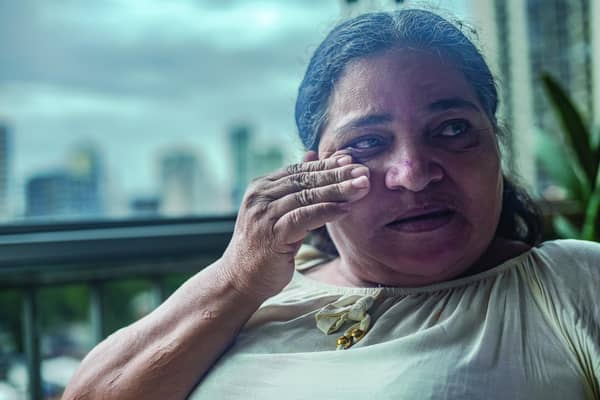
Caroline, 43, who also has two older daughters, faces stark choices every day. "I struggle to feed myself and keep warm. Mentally, it gets to me. Sometimes I dwell on that, and I think, 'What's the point of living?'" she says. "I often think Emma would be better off if I wasn't here, that she'd get a better standard of life in a home."
At the weekend, her Christmas shopping was done wearing a pair of bedraggled boots, the soles so badly worn away they are lined with plastic carrier bags.
The only presents will be for the children. Caroline and Willie cannot afford to buy one another gifts, while they have asked relatives not for iPods, but food.
Peter Kelly, director of the Poverty Alliance charity, said there should be a wider definition of poverty which shows exactly what a person can live on.
"The 60 per cent threshold doesn't say what is an adequate income to live on in Scotland. By saying what the adequate income is, you can set benefits accordingly.
"Poverty in Scotland is about not being able to afford to pay for school trips for your child... not being able to celebrate Christmas or birthdays without getting into debt. It's an enduring myth that we're all getting richer."

Caroline has no grand solutions to her predicament, but believes little gestures would make a difference – a one-off Christmas payment of about £30, or two school uniform grants instead of one.
She will try to ensure next Tuesday is a day to remember for the right reasons. "Emma will be really happy with the Guinness Book of Records," she said. "You should have seen her face when we got our second-hand tree and she asked to decorate it."
MEASURES OF DEPRIVATIONPOVERTY in the UK is usually measured on a relative, rather than an absolute, scale. Absolute poverty is a term often used to refer to a person in the Third World who has insufficient food and shelter, and faces a daily struggle for survival.
Campaigners argue that relative poverty is a more realistic yardstick for the 21st century, comparing general standards of living that have become the norm.
The poverty measure favoured by the UK government, and used by many other bodies worldwide, classifies those with a household income under 60 per cent of median earnings as living in poverty.
This measure is disputed by some, who argue that those living on such an income in reality receive nothing like a "living wage".
Some leading charities believe the definition of poverty should be widened to demonstrate exactly how much a person can live on.
They claim that accurately identifying an adequate minimum level of income is an important step in the fight against poverty. However, this is difficult because the level of income required to meet a family's needs is likely to vary from region to region.
Those living in relative poverty are often excluded from activities such as buying Christmas presents or going on holiday. Once factors such as travel and clothing are taken into account, even low-cost activities, such as visiting the local swimming baths, may be out of reach for many living below the poverty line.
The full article contains 1338 words and appears in The Scotsman newspaper.