







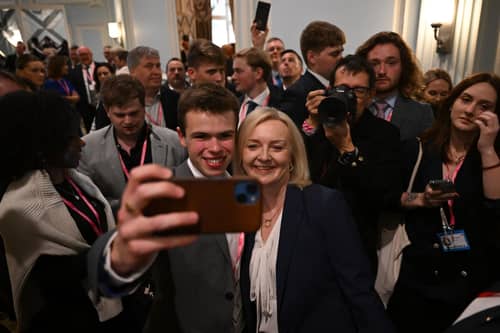
THIS weekend, one question is being asked across America: has the sparsely populated state of Iowa delivered a wake-up call to the world's remaining superpower, sweeping away convention and the political establishment to pick the youthful, passionate, inexperienced figure of Barack Obama to lead it?

Obama addresses supporters at a post-caucus celebration in Des Moines, Iowa. Picture: Getty Images
Mr Obama certainly thinks so. After his stunning win the Democratic primary, beating the favourite, Hillary Clinton, into third place, he told cheering supporters this was a "defining moment" in the history of the United States.
"They said this day would never come; they said our sights were set too high," he said. "Hope is the bedrock of this nation.
"We are choosing hope over fear. We're choosing unity over division and sending a powerful message that change is coming to America."
The numbers are impressive. Only six weeks ago, Mr Obama was all but written-off to the Clinton campaign juggernaut. But on Thursday night, he won 38 per cent of votes, with Mrs Clinton pushed into a humiliating third place on 29 per cent, one point behind John Edwards.
But the win tells only half the story. Among Democrat voters aged under 45, Obama's lead jumps to 50 per cent. Just as important, and just as damaging for Mrs Clinton, Mr Obama won the women's vote, getting 35 per cent against her 30 per cent in what most expected to be her strong suit.
Then there is his colour. Some indication of the momentousness of this win is that it is the first primary success by any black person, ever. And it happened in a state which is 95 per cent white and rural – hardly the traditional battleground for African-American political leaders.
Yet Mr Obama has managed, better than anyone else, to grab hold of the welling discontent building across America. And while Iowa seems untypical of the US demographically, politically its divisions are close to those of the country as a whole. Its preferred candidates have won both previous presidential elections, and many pundits think it is an important barometer of voter opinion.
"This is a bellwether state," Allen Steinberg, professor of history at the University of Iowa, said. "It is representative of the nation as a whole."
For Prof Steinberg, Mr Obama's win is a sign of changing times. "There's a generational shift taking place," he said. "Young people are really concerned. It's a big deal what happened last night, unprecedented in American history."
Democrats of all opinions are also taking heart after a bigger-than-expected turnout, despite freezing weather, with a two-to-one ratio against the Republican Party. Large numbers of independent voters plumped for Mr Obama, a key indicator for the Democrats' old guard that the Illinois senator may be able to win the US's precious middle-ground.
For Mrs Clinton, meanwhile, there is only bad news. Having portrayed herself as the all-but-inevitable candidate, based on experience gained with her husband Bill in the White House, she finds herself struggling to find a new message before the next primary, in New Hampshire on Tuesday.
The "safe pair of hands" from inside the Democratic establishment finds herself confronting an electorate determined to break the mould.
Pollsters have known of this discontent for some time. Congress – both the Democratic and Republican parties – scores even lower ratings that President George Bush, now one of the most unpopular US presidents.
But rather than opt for the Clinton "safe zone", Iowans have indicated a willingness for bold change. "Both parties have opted for change," David Yepsen, of the Des Moines Register, said.
Meanwhile, the negatives that seemed likely to trip up Mr Obama a few months ago are in the rear-view mirror. The voters of Iowa seemed not to mind that he had a few years in a Muslim pre-school in Indonesia, or even that his name sounds so similar to America's arch-enemy, Osama bin Laden.
Nor does his lack of experience – after only three years as a senator – seem like much of a block. Supporters point out that, by definition, nobody gets to the White House with presidential experience, while the experienced old hands now running the White House, some tracing political careers back half a century, are perceived as having made a hash of both the economy and the war in Iraq.
The turning point for Mr Obama was probably on 3 December, when Oprah Winfrey, the talk-show host who is the US's most popular celebrity, led an 18,000-strong rally to support him.
This rally appears to have convinced growing numbers of voters that the 44-year-old senator, while young, has a sensible head on his shoulders.
The word "change" has come to dominate Mr Obama's campaign. A CNN exit poll found that 51 per cent of Iowans thought he was best placed to deliver "change", compared with only 19 per cent for Mrs Clinton, and 20 per cent for Mr Edwards.
What this "change" might be, nobody is too sure. The economy, enduring the long-drawn-out misery of subprime mortgage failures, is No1 in voters' minds.
Healthcare is also up there, with millions wondering why the soaring costs of the country's insurance-based system are so much greater than those faced by taxpayers in other industrialised countries.
The war in Iraq comes some way behind both issues, amid a national consensus that, while not winnable, an early withdrawal might give terrorists a firmer foothold in the Middle East.
But what to do about these issues is fuzzy. "What they want is the change from Bush, (but] most people don't think it through," Prof Steinberg said.
Meanwhile, Mr Edwards, often anonymous in the Clinton-Obama contest, has drawn strength from his second place in Iowa.
He is the most traditionally left-wing of the Democratic candidates, and he completed a 36-hour marathon Iowa election tour before the poll, courting blue-collar workers, with an impressive result.
Many had expected him to succumb early in the race, as several Democratic candidates have done, but he may now emerge as king-maker in what looks likely to be a long three-horse race.
YOUNG VOTERS FLOCK TO BACK OBAMA IN RECORD TURN-OUTMORE than one-third of Barack Obama's support was from voters under the age of 30, eclipsing Hillary Clinton and John Edwards among the young, according to those entering the caucuses. In contrast, more than a third of Mrs Clinton's vote came from people age 65 and older, far more than her closest rivals.
More than half of Mr Edwards' supporters were veteran caucus-goers, while most of his two rivals' backers were first-timers. And a desire for change was like a rocket booster for Mr Obama – half of Democrats said the ability to force change was the pivotal factor in picking a candidate, and half of them backed the youthful Illinois senator.
Turnout among Democrats in Iowa topped 220,000, smashing the previous record of 124,000 in 2004. Mr Obama benefited hugely from a strong turnout by young voters – 22 per cent of Iowa Democrats at the caucuses were under 30, compared with 17 per cent four years ago.
Mr Obama won a staggering 57 per cent of those votes. Young voters are typically harder to lure to the polls than older ones, and it is not certain he will be able to maintain that kind of commitment from them as the contest moves around the country.
He won four in 10 votes of those attending Iowa's caucuses for the first time – a group that comprised more than half of those who showed up on Thursday, an indication of the enthusiasm felt by Democrat party members for the competition.
Just more than half of Obama supporters were single, while more than 60 per cent of Mrs Clinton's and Mr Edwards' were married.
Mr Obama was also able to capture a group many polls showed belonged to Mrs Clinton: women. He got 35 per cent of their support, compared with 30 per cent for Mrs Clinton, a New York senator, and 23 per cent for Mr Edwards. In other words, only three in ten women backed the candidate who would, if victorious, be the first female president.
THE VOTING MADE SIMPLE THE Iowa caucuses marked the beginning of the primary season, when individual states decide which candidate from the Republican and Democratic parties to back in the 2008 presidential election.
In primaries, all registered voters in a state directly vote for their preferred candidate. Caucuses are more complicated, but basically these involve delegates being selected at a county level to represent party members in subsequent votes.
The next big vote will be the New Hampshire primary, on Tuesday. The season is brought to a climax on 5 February with Super Tuesday, when Democrats and Republicans in 22 states vote.
Following this, both parties' delegates from each state will be sent to their national conventions in late summer, when the overall winners are formally chosen to fight the 7 November presidential election.
Why God won't always be on Huckabee's side Alan Fram and Mark Egan RELIGION played a huge role in Mike Huckabee's triumph in the Iowa Republican caucuses, but there are some mixed signals for him on the road ahead.
Eight in ten Huckabee supporters said they were born-again or evangelical Christians, according to an entrance poll. Another six in ten said it was very important to share their candidate's religious beliefs. In both categories, none of the former Arkansas governor's opponents came close to that kind of support.
In addition, six in ten Huckabee supporters – more than his rivals – said it was most important that their candidate shared their values. Only four per cent of his backers said they wanted a contender with experience and – incredibly – just two per cent said they were looking for a Republican who could go all the way and win the White House in November.
With New Hampshire's primaries next Tuesday, the campaign's next stop is a state where only about one in five Republican voters is a born-again or evangelical Christian – about one-third the number who claimed that status among Iowa Republicans.
While 46 per cent of Iowa's born-again or evangelical Republican voters backed Huckabee, a slight majority did not – indicating a willingness to support candidates other than the ordained Baptist minister who has made religion a centrepiece of his campaign.
Mitt Romney, former governor of New Hampshire's neighbour, Massachusetts and a Mormon, got one in five of those voters in Iowa. Romney, whose lead in New Hampshire is challenged by Arizona Senator John McCain, took studied aim at his chief rival in the state to bolster his attack strategy.
Romney wanted to make a one-two punch in Iowa and New Hampshire to seize control of the Republican race, but he is now in trouble, challenged by both Huckabee and McCain, whose penchant for straight talk appeals to the flinty nature of the local people.
Romney told the broadcaster MSNBC that McCain's past opposition to President Bush's tax cuts and support for a plan to give illegal immigrants a pathway to citizenship will work against him in New Hampshire and help Romney.
"I think you're going to hear about it more, and I think the people in New Hampshire will find that very troubling," he said.
McCain responded on Fox News Channel: "I would hope that Governor Romney might have learned a lesson last night that negative attack ads don't work, and let's have a positive campaign here."
The former "zero tolerance" mayor of New York, Rudy Giuliani, is well behind in the New Hampshire polls, holding a weak third place behind McCain and Romney.
The full article contains 1957 words and appears in The Scotsman newspaper.