







Published Date:
21 February 2009
By Jane Fields in Mutare
ZIMBABWE'S president, Robert Mugabe, turns 85 today – but nobody wants to pay for his party.

So far, fundraisers have been unable to raise the £17,500 needed to stage a party in the central town of Chinhoyi next week.
Mr Mugabe's supporters have arranged a dinner dance at Harare's plush Rainbow Towers hotel to try to make up a £10,500 shortfall. A pick-up truck is also to be raffled to raise funds, with state-run ZBC radio running prime-time adverts urging the public to buy raffle tickets before next Friday.
Angry members of the 21st February Movement, which exists solely to raise funds each year for Mr Mugabe's party, have complained that businessmen and farmers who pledged cash and livestock to feed party-goers haven't kept their promises.
They want an inventory made of all those who pledged cash and 80 cattle, 70 goats, pigs, grain and loaves of bread to the party so they can check up on defaulters, according to a radio report.
Temba Mliswa, the chairman of the fundraising committee, had promised the event would be "a thriller". With Zimbabwe bankrupt, Mr Mugabe's supporters had already been forced to scale down their fundraising targets for this year's celebrations – ahead of elections last year they raised the equivalent of £175,000 for the party, held in the southern town of Beitbridge.
Mr Mugabe and his family have got used to lavish presidential birthday parties while the rest of the nation starves, stoking tension in this once-prosperous country.
This year Zimbabweans are so hungry – and so angry – that seven petty thieves have been beaten to death in the last few weeks for robbing neighbours' vegetable gardens and farm plots, according to the official Herald newspaper.
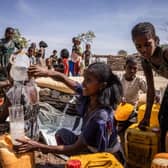
Seven million Zimbabweans need food aid this month, according to the UN's World Food Programme. Zimbabwe's total population numbers around 11 million, although that figure is being eroded by cholera, Aids, malnutrition and the steady flight of tens of thousands of desperate Zimbabweans, mostly into neighbouring South Africa.
During last year's party, protesters just across the southern border in the South African town of Messina hung a banner from a helium balloon saying: "You've had your cake, now beat it." But Mr Mugabe refused to step down after his defeat to Morgan Tsvangirai in the first round of presidential elections in March, instead unleashing a brutal clampdown on Mr Tsvangirai's Movement for Democratic Change that left more than 200 supporters dead.
Mr Tsvangirai has now joined a unity government as prime minister.
The former opposition leader has insisted that this is a transitional arrangement until the next elections, but Mr Mugabe has other ideas.
"I do not know if the forthcoming elections would produce the same results like the last time and we would see if the same arrangement can be made in the future," he told new deputy ministers at a swearing-in ceremony on Thursday.
Mr Mugabe, who has been in power since 1980, was born in poverty on 21 February, 1924 at Kutama Mission north of Harare.
His wife Grace, known scathingly by locals as "Zimbabwe's First Shopper" instead of Zimbabwe's First Lady, caught Mr Mugabe's eye when she was a 20-something secretary.
Three children later, she has a fetish for shoes, diamonds and recently posh handbags: her last acquisition during a family holiday in Hong Kong is reported to have cost nearly £9,000.
Up to $5bn needed to fix broken economy
REPAIRING Zimbabwe's economy could cost as much as $5 billion (£3.5 billion) and foreign direct investment would help, Morgan Tsvangirai, the country's prime minister said yesterday.
The Reserve Bank of Zimbabwe said international and regional financiers had offered Zimbabwe $500 million in credit lines, but were cautious because of conflicting signals on policy.
Zimbabwe's government, formed between Mr Tsvangirai's MDC party and President Robert Mugabe's Zanu-PF, must resolve an economic meltdown that has led to hyperinflation and a virtually worthless local currency. Prices in the country double every day.
"As for the long-term economic recovery, it has not been assessed … but I think it would run into billions of dollars, maybe as high as $5 billion," Mr Tsvangirai said.
He added: "Obviously as a country that is emerging from such a dire situation, foreign direct investment is one of the areas of focus. Anything that is inhibitive for foreign direct investment has to be reviewed."
Zimbabwe's Reserve Bank is looking at currency options. It has repeatedly revalued its dollar and lopped another 12 zeros off the battered currency this month.
The full article contains 767 words and appears in The Scotsman newspaper.
-
Last Updated:
20 February 2009 9:57 PM
-
Source:
The Scotsman
-
Location:
Edinburgh
-
Related Topics:
Zimbabwe