













Help Sitemap Home Skip Navigation Contact Us Disability Statement


Monday, 7th July 2008

Premium Article !

Your account has been frozen. For your available options click the below button.

Options

Premium Article !

To read this article in full you must have registered and have a Premium Content Subscription with the The Scotsman site.

Subscribe

Registered Article !

To read this article in full you must be registered with the site.

Massive increase in wind turbines on horizon for UK


Click on thumbnail to view image

Published Date: 24 January 2008
NEARLY 10,000 wind turbines will be spinning on land and sea by 2020 if Britain is to meet a new renewable-energy target announced yesterday.
The estimated fivefold increase in the number of turbines would be required to meet a new renewable-energy target for the UK under a plan detailed by the European Commission.

Under the proposals, which are still to be agreed by member states, the
UK would have to ensure at least 15 per cent of energy – in the form of electricity, heating and fuel – will come from renewable resources.

Given limited scope to reduce fossil fuels used for transport and heating, renewable electricity supplies will need to make up between 30 and 40 per cent of the total.

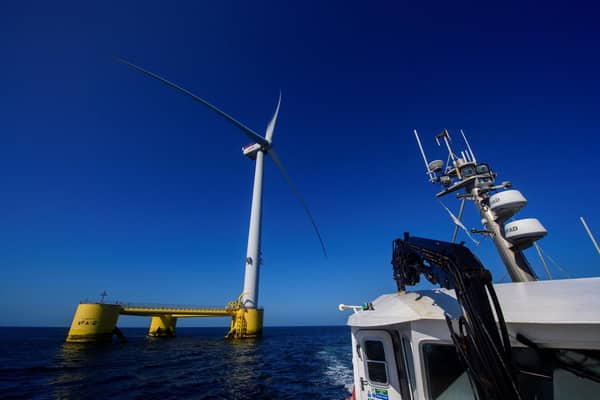
This could potentially mean a total of 5,200 turbines on land and 4,000 on sea, plus a mix of about 5,000 wave, tidal, and small run-of-river hydro and biomass devices by 2020, generating up to 46 gigawatts – or around 37 per cent of electricity demand.

At present, there are 1,800 turbines on land, producing about 1.9 gigawatts of electricity, while offshore schemes are only starting to be developed.

There were conflicting estimates of how much the plan, which also affects gas for heating and transport fuel, would cost.

José Manuel Barroso, the EC president, claimed it would cost every European £2.20 a week, but a Eurosceptic think-tank pointed to a leaked government document which stated the package could cost UK households up to £730 a year. However, the EC said the measures were a vital step in the fight against global warming and other countries must now join the effort.

Mr Barroso said: "Responding to the challenge of climate change is the ultimate political test for our generation.

"Our mission, indeed our duty, is to provide the right policy framework for transformation to an environment-friendly European economy and to continue to lead the international action to protect our planet."

He also said it would curb the EU's rising dependency on imports of fossil fuels.

"We do not want to be dependent on regimes that are not our friends and want to protect ourselves from them," he said.

The British Wind Energy Association (BWEA) said that while at the moment there were only 2.5 gigawatts of wind turbine capacity – the actual electricity produced is less than this depending on the wind – schemes totalling 16 gigawatts were in the planning system.

It forecast that by 2020, 13 gigawatts should come from onshore wind and 20 gigawatts from offshore wind, totalling 27 per cent of electricity demand with sources such as wave, tidal, hydro and biomass providing an additional 8 to 10 per cent.

Maria McCaffery, chief executive of BWEA, said: "This is a revolution for the UK's energy supply. Wind energy is the next North Sea oil. Britain could be a world leader in renewable energy if we have the will to make this vision a reality."

Scotland key to Britain's green power goals

SCOTLAND will make a "big contribution" to the UK's renewable- energy target, industry experts said yesterday.

It is estimated Scotland could generate between eight and nine gigawatts of renewable electricity by 2020, helped by strong winds, waves and tidal flows.

This would meet about half the demand in Scotland. There is scope for much more to be produced if there are technological developments in ways of storing electricity, such as hydrogen fuel cells, new types of batteries and even using compressed air.

Researchers have found that Scotland could produce a massive 60 gigawatts of renewable power. This compares with the present electricity generating capacity of 11 gigawatts from all sources, including coal-fired and nuclear power stations.

Jason Ormiston, of Scottish Renewables, said: "I cannot see the UK targets being met without a big contribution from Scotland – and not just the north-west of Scotland; there's an awful lot of activity in southern Scotland. Longer term, we are looking at wave, tidal and offshore wind."

Winds on the northern and western isles tend to blow about half the time, compared with 20 per cent or less in some parts of England.

"It's windy more of the time, it's wavey more of the time and the Pentland Firth is an enormous resource in terms of tidal energy," Mr Ormiston said.

The SNP-led Scottish Government set a higher target for renewable electricity generation than the rest of the UK, partly because of the desire to exploit the potential of the fledgling marine energy industry.

Jim Mather, the energy minister, said: "The Scottish Government endorses fully the European Commission's ambitions and targets for renewable energy.

We can make a significant contribution to meeting the UK's agreed share of the EU target. Scotland has huge renewable- energy potential, with unrivalled wave, tidal and wind energy resources.

"We have ambitious targets to generate 50 per cent of electricity from renewables by 2020 and are developing an action plan for the production of renewable heat."

'TRIPLE 20' RENEWABLES AIM

EU LEADERS last year agreed to meet a "triple 20" challenge – get 20 per cent of all energy from renewables; cut greenhouse emissions to 20 per cent below 1990 levels; and increase energy efficiency by 20 per cent – by 2020.

However, because the UK has such a small renewable- energy sector, the first of the three targets was set at a less ambitious 15 per cent for Britain yesterday.

Some European countries are already well above the targets.


The full article contains 927 words and appears in The Scotsman newspaper.
Page 1 of 1

 
1

Roger Irrelevant,

24/01/2008 00:20:42
Go Nuclear, people!

You know it makes sense.
2

COLINTON.MAINS,

Oakville Ontario 24/01/2008 00:34:22
THE.COUNTRY.WILL.BLOW.AWAY.IT.IS.TO.SMALL
3

,

24/01/2008 00:49:27
Comment Removed By Administrator
Reason:
4

,

24/01/2008 01:06:04
Comment Removed By Administrator
Reason:
5

Navvy,

24/01/2008 01:07:06
Wind is intermittant while the tides run every day
6

John Blackley,

Florida 24/01/2008 01:19:30
Rickety reporting at its worst. The EU directive will - if implemented - require that Britain increase its energy production from renewables. The EU directive says nothing whatsoever about windmills. This is simply rabble-rousing.
7

steve green,

preston 24/01/2008 01:30:11
When are the eco/green nazis going to be put in their place,probably a suitable tepee,and for once a useful debate on pollution problems be allowed to take place?
Windmills, no chance. Wave power a strong possibility, nuclear a must. Coal power with carbon capture a good proposition. Bio fuels, yes if you want 3rd world countries to starve to death.Britain is now a 3rd world country.
8

,

24/01/2008 06:33:43
Comment Removed By Administrator
Reason:
9

nabodican,

Portree 24/01/2008 07:07:12
If this were to happen it would an unparalleled environmental and economic disaster for Scotland.
The existing fuel poverty problem would be axacerbated and our tourism industry would die.
The poisoning of our uplands with millions of tonnes of concrete would be with us for a thousand years.
The fact that there are already 1800 wind turbines covering hundreds of square miles should tell us something viz : not a single tonne less of coal has been burned because of them and not a single conventional power station has shut down or can be shut down because of them. In fact the only shut down has been of hydro to qualify for rocks.
Wardog : Get your head out of bucket of green sand it is in and look at the facts according to the real world and not that of the ultimate spin doctor Al Gore
10

Rulesbutnotrulers,

Federation, not separation 24/01/2008 07:10:42
Nuclear and windmills? No, thanks.

There are a dozen viable alternatives.
11

Jimmy the Pie,

24/01/2008 07:42:43
How many of these turbines will be manufactured in Scotland?? None, they will all be made in Denmark and Germany. Quite sad really seeing Howdens made turbines in the 70's.
12

Isonomia,

Lenzie 24/01/2008 08:12:19
And where will all these windmills be built? Isn't this just an EU scheme to rob us of power generation jobs and hand them on a plate to European countries?
13

fred bloggs,

Edinburgh 24/01/2008 08:18:00
Total megawatts of installed wind power capacity in the USA as of December:


Texas 4,356

California 2,439

Minnesota 1,299

Iowa 1,273

Washington 1,163

Colorado 1,067

Oregon 885

Illinois 699

Oklahoma 689

New Mexico 496

New York 425

Kansas 364

North Dakota 345

Pennsylvania 294

Wyoming 288

14

Unimpressed one,

24/01/2008 08:23:06
This is a sinister act by the EU to stifle internatiuonal trade. On the horizon is a trade embargo, effective a carbon duty, that will be imposed on all goods coming into the EU from states not doing their bit to commit economic suicide by imposing energy taxes and reducing emissions. So Chinese goods (= ALL manufactured goods) will be priced up to 'compete' with overpriced European goods. America may also fall foul of this lunacy although I would think they will invoke GATT laws to prevent themselves from being penalised. Welcome to the brave new world of eco-insanity!
15

Unimpressed one,

24/01/2008 08:30:17
#9 nabodican, you are spot on there! Scottish tourism is finished if this insanity goes ahead. But of course it will, because there are too many subsidies to be had by all the wind farm companies who are so eager to 'save the planet' whilst lining their pockets at taxpayers expense. Still look on the bright side, when sanity eventually kicks in think of all the jobs that will be created to rip out the stupid windmills. A lose-win situation, unless the jobs go to Romanian labourers then it will be a lose-lose deal. Well done the Scottish government.
16

paulr,

edinburgh 24/01/2008 08:36:37
We should have kicked the EU into touch a long time ago.
17

malkster,

Scotland 24/01/2008 08:53:39
All this talk of installed capacity is misleading. The measure should be the average deliverable capcity for the last year. This would give us an effective measure of what we will actually achieve.
18

Flash67,

Edinburgh 24/01/2008 09:44:17
I wish all sides would be sensible and realise that EVERY means of generating power has a down side: nuclear-disposal, wind-scenery, wave / tidal-marine life impact, fossils-CO2, hydro-drowned valleys, solar-little yield here.....

We need to choose the least-worse option..... no good just whinging about the down sides of everything. For me, we need a mix of renewables, and phase out older fossil stations...


19

Gothic Rose,

24/01/2008 09:58:26
7# So its "Eco Nazis" to wish for the best there is.
20

n/,

Perth 24/01/2008 10:12:04

# Flash67
"For me we need a mix of renewables"!!!!!!!!!!
Would you care to list and advise as to output of said renewables and and whilst doing so explain where base load need is going to come from?


21

AJ Fife,

24/01/2008 10:39:10
Couldn't All 10000 turbines be put simply on St Kilda and create a super duper wind station. Any extra power left over and we could sell it to England.

Shredded Fulmer could become a staple as well!
22

Alternative (High Octane) Fuel Head,

Edinburgh 24/01/2008 11:04:14
All these wind farms will disturb the passage of wind, which may in itself lead to changes in weather due to the unpredictable effects of chaos theory.

I know that is a shot in the dark and may quite well be insignificant but with the existance of the butterfly/hurricane principle in mind, has anyone actually looked at this possibility in depth?

I doubt it.
23

Am-Bodach,

Stirling 24/01/2008 11:15:03
"José Manuel Barroso, the EC president, claimed it would cost every European £2.20 a week..."


The government acknowledges that the cost of this EU ruling will approach 6 billion pounds annually (150 billion over 25 years), dwarfing nuclear subsidy. This cost will be passed on to the UK's 24 million households, and thus electricity bills will increase by 25% - 30%.
24

bogmon,

24/01/2008 11:44:27
Renewable green energy in Scotland and the rest of the UK should be synonymous with home-grown engineering talent producing home-manufactured technology, whose ultimate aim is to generate genuinely sustainable green energy. The savings and the revenue thus generated would benefit our own economy and own population.

Onshore wind farms do not fulfill ANY of the above criteria - and they never will.

When are the brainwashed pro-onshore wind zombies going to get it into their heads that they are being conned??
25

fred bloggs,

Edinburgh 24/01/2008 11:57:20
17. 'Installed capacity is misleading'

Well it is only part of the story. The important measure is the 'Capacity Factor'. This is the energy output, over a year usually, expressed (in kWh) as a % of the maximum theoretical or 'nameplate' output.

The capacity factor of Scottish windfarms is 32%. A nuclear power station can be up to 90% , a coal station 70% and an oil plant 30%, however the output of Scottish coal and nuclear has been a lot lower.
26

fred bloggs,

Edinburgh 24/01/2008 11:59:02
25. I forgot to add that for a wind generator the fuel is free and non-polluting.
27

Dave from Barra ©,

Western Isles 24/01/2008 12:07:38
Why is Scotland being used fo the enire UK's balance sheet for this? Surely, if we seperate Scotland from the UK for stat purposes, we can get away with not having to festoon every hill and brae with these White Elephants, no?
28

fred bloggs,

Edinburgh 24/01/2008 12:33:24
Surveys show that 80% of people like wind farms and that they often become tourist attractions. They can enhance otherwise barren landscapes. Many people find wind farms impressive, hypnotic and calming.

Neutral readers of these threads will usually disregard comments which include epithets such as ‘eco-fascist’, ‘eco-green/nazis’, ‘brainwashed pro-onshore wind zombies’.
29

Dave from Barra ©,

Western Isles 24/01/2008 12:36:15
Surveys show that 80% of people DO NOT like windfarms and they often drive tourists away.

Neutral readers of these threads will usually disregard comments which include epithets such as "pro-green", "eco-friendly" and "saving the planet".
30

Weatherman,

Borders 24/01/2008 12:38:22
#13 Re. USA figures, please note the following which is typical of real world experience rather than BWEA bull: “Because wind is an intermittent resource, it can not be counted upon in California to meet the peak loads on the hottest days of the year. [...] The wind typically does not blow on the hottest days of the year so the wind generation production is usually less than 10% of its nameplate capacity at the time of the summer peak load.” (California ISO integration of renewable resources report , August 2007).
There are some interesting graphs at: http://www.moorsydeactiongroup.org.uk/windpower.html#efficiency
31

Am-Bodach,

24/01/2008 12:39:08
#25 The important measure is the 'Capacity Factor'. This is the energy output, over a year usually, expressed (in kWh) as a % of the maximum theoretical or 'nameplate' output."

Capacity factor is unhelpful in assessing the benefits of renewable energy. The key information needed for this purpose is the fuel displacement in power stations. Some renewable technologies, such as tidal power can efficiently substitute for coal fired baseload. Unfortunately, wind power is blighted by several currently insoluble problems, and does not substitute for fossil/nuclear fuel efficiently. This means that feeding large quantities of wind generated electricity into the national grid is a largely futile (and costly) exercise. In simplistic terms, the energy output of wind farms does not substitute for conventional generation megawatt for megawatt. The true displacement ratio is far less - or should I say worse?
32

Trond,

Norway 24/01/2008 12:56:47
#25 The "capacity factor" will be a function of the consumption i the power grid. Somewhere a controller must hold his hand on the throttle to regulate the production according to the consumption. Windmills cannot be used for the regulation, but hydro and oil can be used. Nuclear will have a high capacity factor as it saves oil.
33

fred bloggs,

Edinburgh 24/01/2008 13:05:21
30. California is not relevant to the situation in the UK. We do not have large numbers of airconditioners which lead to high power consumption in hot weather. In fact we seldom have hot weather. Power consuption is low in the summer in the UK.
34

fred bloggs,

Edinburgh 24/01/2008 13:08:45
31. The fact that the capacity factor for wind is non-zero means that power has been generated and consumed and that during that time some other source of power has been taken off line or reduced in output. That other source is not likely to have been nuclear which is base load, but coal, oil or gas.
35

Gothic Rose,

24/01/2008 13:20:37
Lots of facts blowing in the wind gives me a headache.
36

Trond,

Norway 24/01/2008 13:47:25
One reason that oil has been cheap seems to me to be that it had to compete in the market with even cheaper nuclear. As can be seen from the "capacity factor" figure in # 25 (nuclear 90%) nuclear is not a competitor unless new reactors are built.
37

fred bloggs,

Edinburgh 24/01/2008 13:56:07
29.

Q. Do people like wind farms better once they are built?

A: We summarise over 20 attitude surveys, and a national average of 80% of those questioned support the development of wind power. One study in Wales reveals that before building a wind farm, 68% of the community supported it and 19% opposed it; once built 94% supported it, and only 3% opposed.

- http://www.sd-commission.org.uk/pages/190505-2.html
38

Destroy the Planet,

24/01/2008 14:08:39
Ive had enough of Eco Nazis and Eco Vandals, im off to destroy the planet,
39

fred bloggs,

Edinburgh 24/01/2008 14:20:19
31.

'Unfortunately, wind power is blighted by several currently insoluble problems,'

What would these 'problems' be?
40

n/,

Perth 24/01/2008 14:38:54
#18 Flash67 RE MY QUESTION.(#20).............I note there is STILL no reply.
Wonder why that would be?
The list of renewables please that will somehow fulfill our needs not least our baseload need!
41

fred bloggs,

Edinburgh 24/01/2008 14:44:16
31.

The National Grid Company have stated that 8,000 MW of wind capacity would displace 3,000 MW of conventional plant, with 25,000 MW displacing the need for 5,000 MW. This means that wind power has a capacity value of around 35% at
penetrations of around 6%, declining to around 20% at penetrations of 20%. These figures, along with other corroborating evidence, were accepted by the House of Lords Science & Technology Select Committee in their 2004 report into renewable energy. It is worth noting that the capacity value of wind is higher in the winter than in the summer, in line with seasonal changes in the capacity factor. This means there is a correlation between the capacity value and times of peak demand.
42

connaughtboy,

stonehaven 24/01/2008 14:46:45
#26 Fred

True, but maintaining them certainly isn't free.
43

Geomac 1,

Kinross 24/01/2008 14:57:48
Fred Bloogs

You simply cannot get away from the major problem with wind - that is, it only produces electricity when the wind blows within a specific speed range. Too low wind speed and no power and too high wind speed and the blades have to be feathered.
All this requires conventional backup - recent EON (German power major) indicated that this level of backup was around 70-80% of the wind output.
I assume that you are also aware that windmills are expensive both to build and operate. Recently Brian Wilson (ex UK Energy Minister) admitted on Newsnight that "Wind is only economic because of the subsidies - and in fact developers make more money from subsidies that they do for selling the electricity because of its intermittency"!!!
44

Geomac 1,

Kinross 24/01/2008 15:01:53
I forgot to mention the other main problems with wind's intermittency - it's impact on grid stability! In recent times the German, Spanish and Irish grids have had serious problems with high variablity of wind. Between the 29th Dec 07 and the 2nd Jan 08 the German wind output reduced from 12,000 MW to zero, then increased back up to 10,000 MW on the 3rd Jan and dropped to zero again overnight!! Real time data available
45

Am-Bodach,

24/01/2008 15:13:32
#41

Intermittency and transmission losses alone will negate much of the energy generated by wind farms. Fuel savings should be achieved through the most efficient and cost effective means possible, and not through those most conducive to the profit of the renewable energy industry. I note your links to the national grid etc – have I not discussed these with you previously? Before I take the trouble to read your references, have you actually read and understood them yourself? They are probably based on computer simulation, rather than experimental measurement. I doubt whether the laws of physics differ in Germany and the UK, and thus I would expect wind energy to perform similarly in both countries. Indeed, given the more unstable (and thus less predictable) climate in the UK, I would expect intermittency to pose a more serious problem in the latter country. As yet I have not seen data on the variability (standard deviation) of wind speed in the UK and Germany – I suspect the wind industry would rather not dwell on this subject.

"We summarise over 20 attitude surveys, and a national average of 80% of those questioned support the development of wind power. One study in Wales reveals that before building a wind farm, 68% of the community supported it and 19% opposed it; once built 94% supported it, and only 3% opposed.

- http://www.sd-commission.org.uk/pages/190505-2.html

A Highly contentious and impartial source - particularly since this organisation's report into wind energy (see your own link, Q2) has been criticised for containing mathematical error! I believe that the energy minister has conceded that the numbers of individuals opposed to wind energy are as great as those opposed to nuclear power. You have also referrred to the House of Lords Science & Technology Select Committee. Did this body not highlight a huge level of technical ignorance amongst supporters of wind energy?
46

Trond,

Norway 24/01/2008 15:15:01
# 41: According to your figures:
The first 8 GW windpower would then displace 3 GW (38%) conventional, while
the next 17 GW windpower would displace only 2 GW (12%) conventional plant installation.
This was the first 25 GW windpower.

The article says that 46 GW is planned.
47

Geomac 1,

Kinross 24/01/2008 15:22:36
Re Barosso's cost claims, I doubt that it's well known that last year the ROCs paid out last year in the UK equated to around £40 per household AND that the EU carbon Trading scheme adds a further 7 to 12 in costs. Already we are paying say £140 per household per year - and now another £140 (at the very least) on top of that. Time will tell if people are prepared to accept these costs?
48

Am-Bodach,

24/01/2008 15:30:51
#47

Yesterday's press reports indicated that the government's cost estimates approach 6 billion UK pounds annually, and that these costs would be passed on to consumers - that's 250 pounds for each of the UK's 24 million households!
49

fred bloggs,

Edinburgh 24/01/2008 15:38:56
43. re backup:

All power generators require back up in case of failure. The UK grid already operates with enough back up to replace a large power station. Variations in the output from wind farms are barely noticeable over and above the normal fluctuation in supply and demand. A small amount of additional back up for wind is required at a penetration of 10%. This would amount to around 400MW and would add only about 0.2p per kWh to the generation cost of wind energy.
50

fred bloggs,

Edinburgh 24/01/2008 15:40:37
44. Grid stability only starts to cause problems at high penetration. The UK penetration will be likely no more than 20%.
51

fred bloggs,

Edinburgh 24/01/2008 15:42:05
45. Intermittency is unlikely to be a problem, especially in Scotland with its high wind resource.
52

HA,

Beith 24/01/2008 15:44:04
Onshore wind energy is the least efficient, least reliable, least predictable form of renewable energy. However, thanks to Blair/Brown and their banking advisers they are the most profitable form of alternative energy. This is one of the contributing factors in so many people being driven into fuel poverty.

Scotland should have been in the frame to bring tidal power to the world. Gordon Brown has just given the Chinese £50million of our money so that they can develop alternative energy. New Labour's energy policies have been driven by the bankers, for whom Tony Blair is now officially working.

TRAGIC
53

fred bloggs,

Edinburgh 24/01/2008 15:44:49
47.

Wind power, along with all renewables, is financially supported through the Renewables Obligation. This places an obligation on suppliers to source an increasing percentage of their electricity sales from renewables. The cost of the RO is not paid by the taxpayer, but by consumers through their bills. The Government also provides some taxpayer support for other renewables, such as offshore wind, wave and tidal power, with the aim of helping them to become competitive in the longer term. The subsidies being given to renewables now must be contrasted against the huge subsidies (explicit and hidden) given to fossil fuels and nuclear power over the years.

54

Weatherman,

Borders 24/01/2008 15:49:51
#33 FB says that California's experience is not relevant. However, the same story is heard from everywhere there is big wind: supply does not follow demand.
His point about winter production is a very partial truth. If you examine the figures, you will find that WTG's produce most at periods of least demand. Anybody with senses will observe that wind speeds are lowest at periods of peak demand at dawn and dusk in the winter.
The mirror of the California experience is periods of high pressure in winter when we experience very low wind speeds, and temperatures.
And before FB trots out Graham Sindens dodgy 'wind smoothing' paper, I suggest he reads the Oswald Consultancy's modelling of the behaviour of a very large installed capacity in the UK. This uses Ofgem's and the Met Office's real world data: http://www.ref.org.uk/energydata.php
55

fred bloggs,

Edinburgh 24/01/2008 15:51:46
55. Wind generators are very reliable, maintenance costs are low and the fuel is free so efficiency is not a useful concept. All that matters economically is the capital cost, operation and maintenance costs. The capital cost is paid off in months and the other costs are small.
56

fred bloggs,

Edinburgh 24/01/2008 15:55:19
57. UK wind speed records show that wind power availability is greater in winter and that the wind is on average stronger during the day when demand is also greater than overnight

Low wind speed conditions throughout the UK are extremely rare.

A modern wind turbine produces electricity 70-85% of the time, but generates different amounts of power depending on the wind speed. Over the course of a year it will typically generate about 30% of the theoretical maximum output i.e. it will have a capacity factor (or load factor) of 30%. A nuclear power station can be up to 90%, a coal station 70% and an oil plant 30%.
57

Unimpressed one,

24/01/2008 15:56:21
Fred bloggs, you really do talk some rubbish these days. Of course taxpayers are footing the bill. How many taxpayers don't consume power? Wind power is hopelessly uneconomic unless it is subsidised! Pillock.
58

Am-Bodach,

24/01/2008 16:02:14
#54

"Intermittency is unlikely to be a problem, especially in Scotland with its high wind resource."

Studies (e.g. Leonhard & Muller, Elektra 2002) have highlighted the problems of intermittency, specifically at low levels of penetration.

#58

" Wind generators are very reliable, maintenance costs are low"

This is a ridiculous statement, divorced from reality. Wind turbines are highly unreliable. Gear boxes have failed in thousands of wind turbines, with some wind energy developments requiring a second retrofit in less than five years. Unsurprisingly, the journal "Windpower Monthly" has alleged that the wind industry has attempted to shroud the gear box problem in secrecy.
59

The Strategist,

24/01/2008 16:05:25
#48

By "efficient" the EU means those countries which have put in place the infrastructure (grid),mechanisms (planning and funding) to roll out renewables reasonably quickly.

Now the EU has made it possible for electricity companies to acquire ROCs anywhere the lack of infrastructure and mechanisms in Scotland will work against us and could actually reduce investment levels.

In other words the EU is favouring those countries that are innovating across the board.. That can't be said of Scotland or the UK. There's a strong possibility we will loose out due to previous inaction.
60

Weatherman,

Borders 24/01/2008 16:05:53
Further to #57:

In October 2007, East Lothian and Borders recorded a mean wind speed for the month of 2 metres per second (3.7 knots). This is less than it needs to get a modern WTG to begin generating.

#59 FB - I note that you completely avoid answering to the point, preferring to parrot BWEA garbage.

61

Geomac 1,

Kinross 24/01/2008 16:32:00
53 and 56 Fred Bloggs

of course it's the electricity consumer who pays!! I never said taxpayer - I'll bet that few of the consumers in the UK know to what extent they are subsidising renewables!!

The Irish grid became unstable at 11% and all windmill building had to stop!!
62

Geomac 1,

Kinross 24/01/2008 16:33:41
54 Fred again! Please don't try to tell me that in Scotland the wind will always be blowing somewhere - that is the argument of the scoundrel - not to mention a very expensive capital investment for even less than the average 255 capacity to be achieved.
63

Geomac 1,

Kinross 24/01/2008 16:36:09
61 - you are spot on - wind turbine gearboxes are failing all over the place. Some turbines are even falling down!
The magazine ReNews will also tell you about the problems - and they are getting more and more serious!!
64

Geomac 1,

Kinross 24/01/2008 16:37:59
Fred - do you work for BWEA or Scottish Renewables??
65

Geomac 1,

Kinross 24/01/2008 16:39:52
If someone says again that Scotland is or can lead the world in renewables, I'll scream!! The government doesn't know how!!
66

fred bloggs,

Edinburgh 24/01/2008 16:42:48
61. I just googled "wind turbine failure" in Google News and got zero hits!
67

Dave from Barra ©,

Western Isles 24/01/2008 16:48:07
Scotland - The oily-est country in the UK
Scotland - The windiest country in the UK.

We shared the oil with the rest of the UK and did us no good.

You want us to share our wind too. You will have to pay for it as we will have to pay for it by the destruction of habitat and ruination of unfettered landscape.
68

Dave from Barra ©,

Western Isles 24/01/2008 16:50:20
Gosh Fred, I just googled "wind turbine failure" and got 158,000 hits in under 0.28 seconds.

Me thinks you are either a big fat liar or you are using a different google to the remainder of the planet.
69

fred bloggs,

Edinburgh 24/01/2008 16:57:02
71. Google NEWS.
70

Dave from Barra ©,

Western Isles 24/01/2008 16:58:39
Q. Do you think wind turbines, once built and erected, add value to a landscape?

A. Yes in some situations, no in others.

Q. Have you ever visited and/or lived in any of the remote areas of Scotland the turbines may be erected?

A. No.

Q. Do you think you would visit these areas?

A. Maybe/Yes.

Q. Do you think you would appreciate these areas of unspoiled vistas and quietness once many huge turbines are erected?

A. Probably not.

www.made_up_questionnaire/depends.how.you.phrase.the.question.co.uk
71

Dave from Barra ©,

Western Isles 24/01/2008 16:59:40
Use Google as a search engine, as that's what it is designed for. I'm geting a clear picture now Fred.
72

Am-Bodach,

24/01/2008 16:59:45
#69

Give us a break Fred - Zero hits in Google News!

In a single year, 1511 turbines developed faults in Germany - do you call this reliable?

Try: "Gearboxes — the Achilles heel of wind power
engineering" Windpower Monthly, November 2005
73

fred bloggs,

Edinburgh 24/01/2008 17:03:36
71. Googling the phrase "wind turbine failure" in double quotes (to search for the exact phrase only) gives 907 hits on the web as opposed to zero in News.
74

Dave from Barra ©,

Western Isles 24/01/2008 17:12:38
Sorry Fred. That is not protocol for using search engines.

By doing so, you eliminate too much information. Oh dear. The picture is getting clearer now.
75

fred bloggs,

Edinburgh 24/01/2008 17:17:34
'High-quality modern wind turbines have an availability factor above 98% (i.e., the turbines are on average ready to run during more than 98% of the hours of the year). This availability factor is beyond that of any other electricity generating technology. Modern wind turbines require maintenance checks every six months and are built to very exacting industrial standards.'
76

Dave from Barra ©,

Western Isles 24/01/2008 17:25:42
What's the availabiliy factors for coal, oil, gas and nuclear stations? i.e. % they are available to run - hours of every year?

Assuming they are also built to exacting industrial standards and that they do not depend on a unpredictable input source i.e. for as long as a station is fed coal/gas/oil/ nuclear.
77

Weatherman,

Borders 24/01/2008 17:34:17
"Rotor blade lightning damage is a common problem." Quote from company that builds and repairs them (NGup Rotor Blades).
You might also ask why Vestas have withdrawn what was supposed to be the market-leading V90 turbine.


78

fred bloggs,

Edinburgh 24/01/2008 17:34:50
Availability factors for coal stations are 70-90%
79

fred bloggs,

Edinburgh 24/01/2008 17:41:13
80.

Vestas receives orders for a total of 54 MW for the Spanish market
'Vestas has received two orders for a total of 27 wind turbines for two projects in Spain. Elecnor has placed an order for 15 units of the V90-2.0 MW wind turbine for the Lezuza project, and Isolux Ingeniería, S.A. has placed an order for 12 units of the V80-2.0 MW turbine for the Cova da Serpe project.'

22.1.08
80

Weatherman,

Borders 24/01/2008 18:21:51
Sorry, hands up to an error in #80:

"V90-3 MW withdrawal
Vestas Wind Systems of Denmark recently announced the withdrawal of its V90-3 MW flagship model from the offshore market, which is already employed in major offshore projects like Kentish Flats and Barrow (UK) and OWEZ (NL). According to industry sources the world’s largest wind turbine manufacturer is developing a ‘completely new’ offshore wind turbine model. The withdrawal action is said to be a response to multiple gearbox problems reported at several of its turbines operating offshore and onshore. Further details on the new/optimized/revised turbine model are not yet available."
Source: Renewable Energy world - 'Husum 2007 Wind technology overview'.
http://www.renewable-energy-world.com/display_article/314134/121/CRTIS/none/none/1/Husum-2007-Wind-technology-overview:-2007-at-HusumWind/
81

Jade,

Argyll 24/01/2008 19:16:46
I suggest Fred Bloggs has got to be either brain dead or an employee of BWEA etc. I hope he's got a domestic wind turbine, solar panels and a geothermal heat pump for his house! Fred has never heard of Derrybrien or the vast infrastructure required to build these on land and how they can damage the environment they're supposed to be so friendly to. Oh, I forgot, Fred is obviously well able to afford the cost of paying for ROCs that add to his bill.
Dave from Barra - much as I love Barra and indeed the whole of the Western Isles I will never come back if the place has loads of wind factories - just like a lot of my visitors!
82

Dave from Barra ©,

Western Isles 24/01/2008 19:29:17
Fred. You know the protocal. Proof of assertion that coal (I note no mention of other power generation) is only 70 - 90% availability please.

Lets also note that if true (the 70 to 90%) that for that 70 to 90%, it's 100% generation, not the, at most, 30% that wind turbines can manage.

Jade

I know that. It worries me.
83

Geomac 1,

Kinross 24/01/2008 20:00:47
71 Dave

I got the same number! Methinks Fred is fibbing!!

84

Geomac 1,

Kinross 24/01/2008 20:04:09
84 Jade
I couldn't have put it any better - you have to admire his tenacity and stamina but it's an uphill battle
Hats off to Fred but sorry friend - you're sunk!
85

Colin, Glasgow,

24/01/2008 20:56:17
Give Fred a break. Basically what is saying is true.

He's not proposing more than 20% penetration for wind, so intermittency is not a problem for the grid.

True, the ROC ensures that the consumer subsidises renewables - but that is exactly how it should be. (Fossil fuel is subsised by _everybody_ because everybody has to pay for the substantial health and environmental consequences of using it.)

Wind power is the choice of the market. The ROC supports all renewables equally, except large hydro which has limited expansion potential. The market chooses wind because it is the cheapest renewable available.

Note, as far as I can see, Fred is not excluding nuclear in the solution. A combination of wind, nuclear and hydro is the optimum solution. Wind can be deployed quickly in the short term; nuclear provides cheap base load; and hydro provides peak/storage capacity.

It's all very well suggesting wave, tidal or carbon capture, but none of these are currently viable, it is unlikely that any of them will be viable on a large scale in the next decade, and it is possible that none of them will ever be viable. In the next decade wind is the only player (followed by nuclear asap).

PS Load factor for a coal plant is 90% according to the UK Energy Review (table B1)
http://www.berr.gov.uk/files/file32014.pdf
86

Am-Bodach,

24/01/2008 21:25:02
#88 "A combination of wind, nuclear and hydro is the optimum solution."

Er - not if you read the leading wind industry journal Windpower Monthly, which describes running wind and nuclear together as "frought with problems", since both require "must run" status for economic viability. Similar issues have emerged running wind and CHP in parallel in Denmark, leading to a surplus in electricity production, rather than fuel and emission savings. From the standpoint of the consumer and the environment, I suspect the ideal proportion wind energy in our generation mix is in fact zero. The only losers would be those with vested interests.
87

Dave from Barra ©,

Western Isles 24/01/2008 21:30:38
Shaw Colin!

Always prepared to give Fred a break. He's essentially a good guy, no doubts. However, I will not and cannot stand only one side to the argument. Never.

Geomac1

Yes. I believe we might have a common friend too. You are of Kinross, aye? The Stewarts not far away? I've heard Mr Stewart may have, regrettably, passed away?
88

Colin, Glasgow,

24/01/2008 21:34:34
#89 If we already had 80% nuclear then you would have a point. But we don't, and we couldn't have within the next decade. Wind is appropriate within the next decade to displace the use of fossil fuel.

In 50 years I expect wind turbines will be quaint artefacts of a bygone age, but at the moment they have an important role.
89

Dave from Barra ©,

Western Isles 24/01/2008 21:42:07
Gosh Colin!

You may be right! A veil of tears indeed!

Sincerely friend
90

Colin, Glasgow,

24/01/2008 22:29:28
What are you proposing as a short-term alternative to wind farms? As in: what can generate electricity on a scale of gigaWatts; and can plug the gap until the next generation of nuclear plants are built?
91

Trond,

Norway 24/01/2008 22:45:17
Finland is planning another two nuclear power plants:

http://en.wikipedia.org/wiki/Nuclear_power_in_Finland

India builds thorium reactors, they leave less radioactive waste than uranium reactors:

http://news.bbc.co.uk/2/hi/south_asia/6219998.stm
92

truthsleuth,

25/01/2008 00:43:52
All this Windpower etc is to save the weak politicians confronting the petrol head lobby with the real solution ie taxing motor fuel and achieve a REAL shift to less damaging means of transport and or fuel.
93

Greenheatman,

TAIN 25/01/2008 07:26:19
My invention Gentec venturi is the only solution - base load electricity at full capacity 24/7 from an intermittent resource.

It isn't going to be cheap to implement - but a lot cheaper than nuclear and coal in the long run - oh, and it will reduce carbon emissions to zero!

...........so why are we still having this debate?

www.greenheating.com
94

HA,

Beith 25/01/2008 11:33:18
On shore wind turbines are the least efficient form of "alternative energy". They're not exactly green as the manufacture of cement is extremely energy intensive, we lose lots of land to the structures and their associated roads, trenches, quarries etc. In Scotland and Ireland's peat moors they cause landslides and pollute rivers. Oh and they take energy FROM the grid when there is too little and too much wind or when they malfunction,a regular occurence in North Ayrshire.

However, Blair, Stern and Brown and the others in the banking fraternity who have framed our "environmental polices" have ensured that they are the fastest route to get rich quick, for the banks and corporate investors.

It's all abaout money.
95

william john,

ayr 25/01/2008 13:34:55
Great thing wind power the windjammer ships sailing the seas got becalmed for long periods and unless we place less reliance on wind power we will be in the same boat The actual power generated by wind farms average 25-28% of rated capacity Come on tell me otherwise some hope as soon as the debate gets into actual figures thats the end .
waste of power is the biggest user of energy steet lights on at night motoways illuminated from on end of the country to the other office blocks lit up after working hours and can probably be seen from outer space
Cars travelling at 70-90 miles an hour consuming at least 20% more fuel (petrol doesent appear expensive with everyone able to afford 20% more than £1.03 per litre.
If we want to reduce co2 and it would appear that we need to then come on get real and introduce some measures to curb this exta useage me I havent cut back on anything yet untill i see some real efforts being made Wind farms are at present only coping with the extra capacity need to meet the additional energy demands ,Check that one out and find out how the energy demand and co2 pollution keeps rising.