








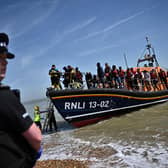



MOST thought it was a crime that had all but died with Jesse James and Butch Cassidy. But the train robbery is back and it's happening in Scotland's very own Wild West.

Scotland on Sunday can reveal gangs of modern-day outlaws are raiding trains as they pass through what some rail insiders have dubbed the "Badlands" of North Lanarkshire.
True, today's robbers have adapted to modern technology: instead of horses
they are riding quad bikes and instead of Colt 45s they are brandishing mobile phones and lock knives. British Transport Police said yesterday it was investigating four robberies or attempted robberies of freight trains. The most recent was this month, at Craigneuk near Motherwell. All four were carrying goods for supermarket giant Tesco.
A source said: "It is completely crazy, like something out of the Wild West. You've got kids in quads tearing after the trains, waiting for them to stop and slashing open the freight wagons and helping themselves to stuff."
Some rail insiders suspect there may have been other attacks, but that they went unnoticed or unreported. Regardless, a posse of train companies, track owner Network Rail and BTP have vowed to put an end to the raids.
Law enforcers have new technology, too. BTP has borrowed a railway helicopter to spot quad-bike raiders before they pounce. And, for the first time in their history, BTP officers have mounted up on motorbikes to catch up with thieves.
"We will continue to use our resources intelligently and use innovative resources such as the Network Rail helicopter to detect and deter those who think the railway is an environment where crime can take place," said a BTP spokesman.
The last officially reported raid, which was unsuccessful, was on November 12. BTP said "persons unknown" had sought to steal goods from a train stopped at a signal near Craig-neuk, effectively the Dodge City junction of Scotland's railways. Inquiries, said a spokesman, "are continuing". Another attempted robbery was recorded at Craigneuk on May 22, 2007.
Raiders were more successful in nearby Wishaw. They got away with cases of alcohol from a Tesco train after a robbery on February 22 this year. There was an attack on a train in the area in August 2007.
In a later sweep of railway lines just one individual was caught: a 12-year-old armed with a knife was dealt with by the authorities last year.
Police and rail officials fear the raiders, many of whom are believed to be children or teenagers, could be seriously hurt. "Anyone trespassing on the railway to commit an act of criminality is extremely foolish and puts themselves in grave danger, with our first concern being for the safety of all railway users," said the BTP spokesman.
Law enforcement sources last night stressed that the raids were part of a growing concern over teenage gangs on the railways. Lines are often effectively the borders between rival territorial groups.
The new raids come as a considerable quantity of freight switches from the roads – where supermarket lorries are also targeted by robbers – to the railways.
Tesco has been making a daily rail shipment through Craigneuk and Wishaw. The service, operated by freight firm DRS, often uses 'curtained' wagons that are easy to slash open. The firm said it was now increasingly turning to hard containers that are more difficult to break into. The raiders, meanwhile, are likely to find there is less prey for them. Network Rail and DRS are working to make sure trains make as few stops in the 'Badlands' as possible.
"We are working to make sure our trains run straight through without stopping at signals," said Eva Foran of the freight company. "Because these robberies, however rare, are an issue for us."
A spokesman for Network Rail said: "We have also worked closely with freight operators to check that trains are not held for long periods in areas where they may be targeted by thieves."
There are six Tesco services through Lanarkshire a day, all headed from Daventry in Northamptonshire to Grangemouth near Falkirk.
Tesco declined to comment on the raids.
The full article contains 691 words and appears in Scotland On Sunday newspaper.