



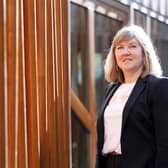





IT WAS the news every woman dreads. Linda Lucas, a 51-year-old teacher from Cupar, Fife, had been to see her GP suspecting she might have a lump in her breast.

Three weeks later, a mammogram at her local hospital was arranged. The prognosis was worse than even she had feared. "The GP hadn't been able to find a lump, but the scan showed that I had a seven centimetre tumour," she recalled.
When her surgeo
n assured her she would be dealt with as a priority, she at least knew the cancer would be removed quickly. It was then she got a second shock. "I was told it would be eight to nine weeks. I just felt it was unacceptable.
"Once you have had the diagnosis you want to have the thing done. The longer it is in your body, the more chance it has of spreading."
Lucas had medical insurance so chose to go private. Within three weeks she had had a successful mastectomy and is now clear of the disease.
But many others are not so fortunate. Thirteen years ago, Liz, 53, from Edinburgh, who asked us not to reveal her full name, had a bowel tumour the size of an orange removed.
In January this year she began getting pain from her bowel again and requested an appointment at Edinburgh's Western General for a colonoscopy. She has seen a specialist but is still awaiting treatment.
"I am yet to receive a colonoscopy as they didn't have the staff to do one," she said. "It seems crazy that someone with my history should have to wait so long for an appointment.
"No patient who might have cancer should have to wait even a few weeks, as it is so distressing." For hundreds of people across Scotland this is the awful reality.
As we reveal today, despite millions of pounds of extra investment, the crisis of Scotland's cancer waiting lists continues to devastate families.
Cancer remains the biggest cause of death in Scotland. And unlike the other two big killers, heart disease and stroke, rates of death from the disease rose marginally last year. A total of 15,144 people in Scotland were killed by cancer in 2005, with lung, bowel and breast cancer the most common causes.
Ministers have responded by insisting patients should be seen more quickly after they are referred to hospitals for treatment by their GPs. Last month, however, health minister Andy Kerr was forced to accept that one target - to ensure all urgent referrals are reduced to two months - had not been met.
With typical candour, Kerr admitted such long waits would not be acceptable for his own family. "If my wife or I had a suspicion we had cancer, I would want my wife or any member of my family to be treated quicker," he said.
But the new figures revealed today by Scotland on Sunday show last month's cancer treatment statistics were just the tip of the iceberg.
Counting both urgent and so-called 'routine' cancer cases, they disclose that patients can wait over a year from the moment their GP takes their case to a hospital before finally getting treatment.
At the Western Infirmary in Glasgow, a patient was forced to wait for 305 days as a result of an administrative error after the GP's referral note apparently got lost.
At Glasgow Royal Infirmary, the average wait for a bowel cancer victim before treatment is five-and-a-half months.
The findings have already triggered a bitter row within the cancer treatment fraternity. Some specialists insist delays can be justified.
One lymphoma patient at Perth Royal Infirmary waited an astonishing 525 days before getting treatment, according to the Scottish Executive figures.
But Dr David Meiklejohn, of NHS Tayside, insisted: "Early treatment can be detrimental as the tumour can develop resistance."
Health chiefs say that in many cases - especially with elderly people - aggressive treatment may be counter-productive, making it better to wait.
But such arguments receive short shrift from other experts. Professor Gordon McVie, former head of Cancer Research UK, and one of Europe's leading cancer specialists, said there were hardly any cases where delays could be explained away.
In a 21st-century health service, he argues, hospitals should be able to both improve a patient's health while, at the same time, treating their cancer.
The consequences of delay, he said, were devastating. "In lung cancer, if you don't get it at stage one then there is a 95% chance of dying. The real challenge is to find people early and to treat them early. It isn't an easy task, but cancer care is a national priority in Scotland so you have got to attack it in a justifiable way."
Scottish ministers are increasingly concerned about the lengthy waits in cancer care, and view it as their Achilles heel as they head towards the Scottish elections next year - desperate to avoid opposition claims that they have failed to improve patient care.
The frustration in the Executive over the cancer figures is easy to detect. An extra 300 doctors, nurses and other health professionals are now working in cancer care in Scotland, compared with 2001. So why, ministers ask, has their extra investment failed to produce results?
Worse still, health ministers in England are crowing over recent figures which show that 91% of people who are urgently referred for treatment are treated within two months, compared with only 74% north of the Border.
Kerr blames slack management procedures at a local level for the failure to achieve targets. He is now adopting a hands-on approach, establishing a specialist hit squad of clinicians who are focusing on bowel cancer, where the longest waits currently occur.
Kerr is demanding answers from all health boards as to why they force cancer patients to wait more than six months.
If they fail to demonstrate that there are sound clinical reasons for so doing, Kerr is warning of direct action. The stakes are high. "The election will be decided largely on the state of the health service," said one senior Labour source.
For patients still waiting, however, all talk of elections is an irrelevance. Linda Lucas recently had a breast reconstruction, following her mastectomy. "The care I got has been fantastic," she said. "But I was supposed to have received the reconstruction within six months. I waited a year."
The full article contains 1088 words and appears in Scotland On Sunday newspaper.